+91-7624021071
 Download Brochure
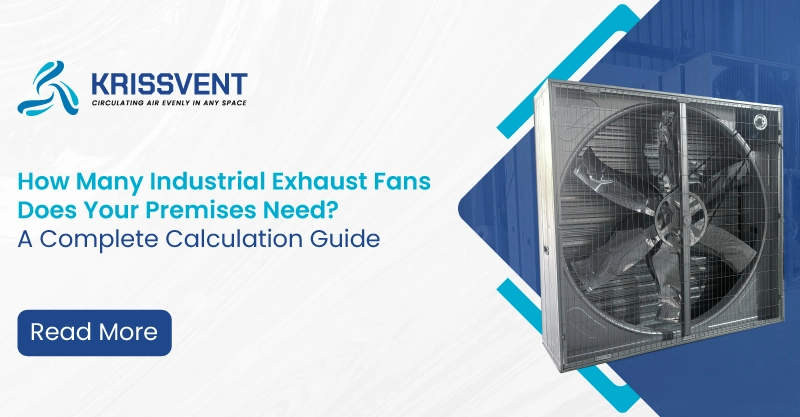
Proper ventilation plays a critical role in maintaining air quality, temperature balance, and safety in industrial and commercial buildings. One of the most common mistakes businesses make is installing industrial exhaust fans without accurately calculating how many exhaust fans are actually required for their premises.
Installing fewer fans than required leads to heat buildup, poor air circulation, and unhealthy working conditions. On the other hand, installing too many fans increases energy consumption and operational costs. This complete calculation guide explains how to determine the exact number of Industrial Exhaust Fans your premises needs for efficient and long-term ventilation performance.
Why Calculating the Right Number of Industrial Exhaust Fans Matters
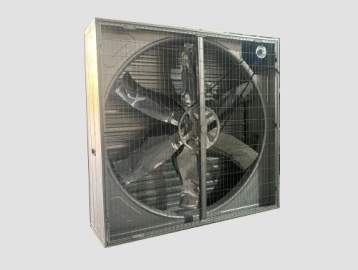
An Industrial Exhaust Fan is responsible for removing hot air, fumes, dust, moisture, and airborne contaminants from enclosed spaces. Correct fan quantity calculation ensures:
- Effective heat and pollutant removal
- Consistent airflow across the entire premises
- Improved worker comfort and productivity
- Compliance with ventilation and safety norms
- Optimised energy usage and lower maintenance costs
Key Factors That Decide How Many Industrial Exhaust Fans Your Premises Needs
1. Total Area and Height of the Premises
The size of your premises directly impacts ventilation requirements. Buildings with large floor areas and high ceilings hold a higher volume of air, which increases the need for more exhaust fans.
Room Volume = Length × Width × Height
Higher volume means more air needs to be exhausted per hour.
2. Required Air Changes Per Hour (ACH)
Air Changes Per Hour (ACH) refers to how many times the entire air volume inside a space should be replaced in one hour.
Typical ACH guidelines:
- Warehouses: 6–10 ACH
- Manufacturing units: 10–15 ACH
- Heat-intensive or polluted environments: 15–25 ACH
A higher ACH requirement directly increases the number of industrial exhaust fans needed.
3. Nature of Industrial Activity
Different applications generate different levels of heat, fumes, and airborne contaminants. For example:
- Welding and fabrication units require higher exhaust capacity
- Chemical and pharmaceutical facilities need continuous fume extraction
- Food processing units require humidity and odour control
The heavier the load, the more exhaust fans your premises will require.
4. Heat Load from Machinery and Equipment
Machines, furnaces, compressors, and production lines generate significant heat. Premises with dense machinery setups require additional industrial exhaust fans to remove trapped hot air effectively.
5. Fresh Air Inlets and Cross Ventilation
Industrial exhaust fans work efficiently only when fresh air can enter the building. Poor air inlet planning may require additional fans to maintain airflow balance and avoid negative pressure issues.
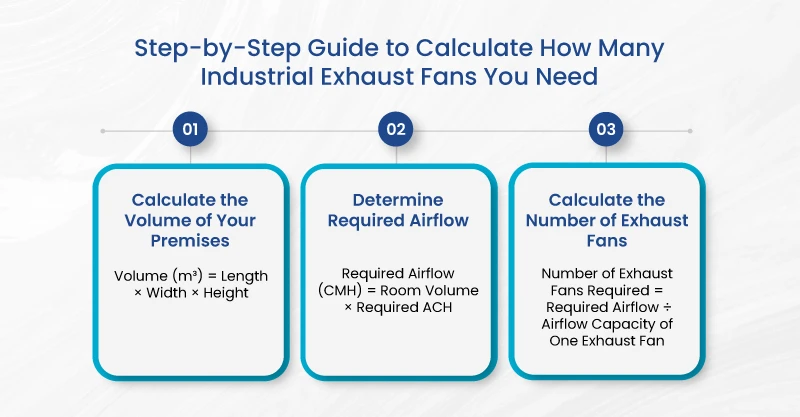
This calculation gives a clear estimate of how many industrial exhaust fans your premises needs for effective ventilation.
Explore Industrial Exhaust Fan Calculator
Use an Exhaust Fan Calculator for Accurate Results
Manual calculations can be complex and time-consuming, especially for large or multi-zone industrial spaces. To simplify this process, KRISSVENT provides a dedicated tool to Calculate how many exhaust fans needs for your premises based on area, height, and application type.
Using an exhaust fan calculator helps:
- Avoid under- or over-installation
- Improve ventilation efficiency
- Reduce energy and maintenance costs
- Ensure accurate planning for current and future needs
Common Mistakes to Avoid When Calculating Exhaust Fans
- Ignoring ceiling height while calculating airflow
- Underestimating heat and pollution levels
- Not planning for future expansion
- Installing fans without adequate fresh air inlets
- Selecting fan quantity based only on budget
Avoiding these mistakes ensures long-term ventilation efficiency and healthier indoor environments.
Why KRISSVENT Industrial Exhaust Fans Are a Reliable Choice
KRISSVENT industrial exhaust fans are designed to deliver:
- High airflow performance for large spaces
- Energy-efficient and durable operation
- Low maintenance requirements
- Compatibility with industrial ventilation systems
- Reliable performance in demanding environments
When combined with accurate fan quantity calculation, KRISSVENT solutions ensure optimal ventilation without unnecessary energy consumption.
You may like to read this: Types of Industrial Exhaust Fans
FAQs
1. How many industrial exhaust fans does my premises need?
2. Does ceiling height affect exhaust fan requirements?
3. Can fewer high-capacity exhaust fans replace multiple smaller ones?
4. Is using an exhaust fan calculator better than manual calculation?
5. Should industrial exhaust fans operate continuously?
Conclusion
Understanding how many Industrial Exhaust Fans your premises needs is essential for designing an efficient and cost-effective ventilation system. By considering space size, activity type, heat load, and airflow requirements, businesses can ensure better air quality, improved comfort, and long-term energy savings.
Using KRISSVENT industrial exhaust fans along with a reliable calculation approach or calculator ensures your ventilation system performs efficiently today and scales effectively for the future.