+91-7624021071
 Download Brochure
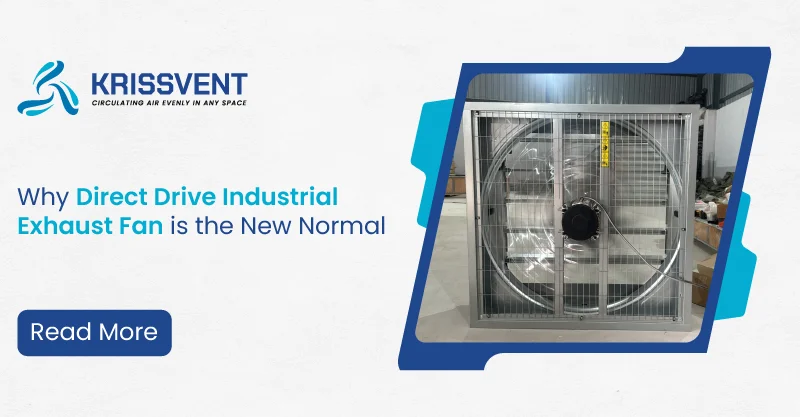
Industrial ventilation has evolved significantly over the years. Traditionally, belt driven exhaust fans were the preferred solution for factories, warehouses, and commercial buildings. However, with advancements in motor technology, energy efficiency, and maintenance design, direct drive exhaust fans have now become the new normal in modern industrial ventilation systems.
This blog explains the differences between direct drive and belt driven exhaust fans and why industries are increasingly shifting toward direct drive technology.
What Is a Direct Drive Exhaust Fan?
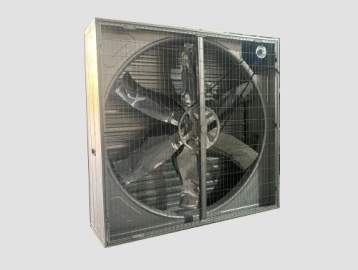
A direct drive exhaust fan has its motor directly connected to the fan impeller. There are no belts, pulleys, or external transmission components involved. This design allows the motor to transfer power directly to the fan blades with minimal energy loss.
Key characteristics of direct drive exhaust fans:
- Compact and integrated motor design
- Fewer moving parts
- Higher energy efficiency
- Lower maintenance requirements
- Quieter operation
What Is a Belt-Driven Exhaust Fan?
A belt-driven exhaust fan uses belts and pulleys to transfer power from the motor to the fan impeller. This traditional system allows speed variation by changing pulley sizes but comes with additional mechanical components.
Key characteristics of belt-driven exhaust fans:
- External motor with belt and pulley system
- Adjustable fan speed
- Higher maintenance due to belt wear
- Increased energy loss over time
- Larger installation footprint
Direct Drive vs Belt Driven Exhaust Fans: Key Differences
1. Energy Efficiency
Direct drive exhaust fans are more energy efficient because there is no power loss through belts or pulleys. Belt driven systems lose efficiency over time due to belt slippage and wear.
2. Maintenance and Downtime
Belt driven exhaust fans require regular belt inspection, tension adjustment, and replacement. Direct drive exhaust fans eliminate belt-related maintenance, significantly reducing downtime and operational costs.
3. Reliability and Performance
With fewer moving parts, direct drive exhaust fans offer higher reliability and consistent performance. Belt driven fans are more prone to breakdowns caused by belt failure or misalignment.
4. Noise and Vibration
Direct drive exhaust fans operate more quietly with reduced vibration, making them ideal for environments where noise control is important. Belt driven systems often generate additional noise due to belt friction.
5. Installation and Space Requirements
Direct drive exhaust fans have a compact design and are easier to install, especially in confined or retrofit applications. Belt driven exhaust fans require more space for motor and belt assembly.
Why Direct Drive Exhaust Fans Are the New Normal
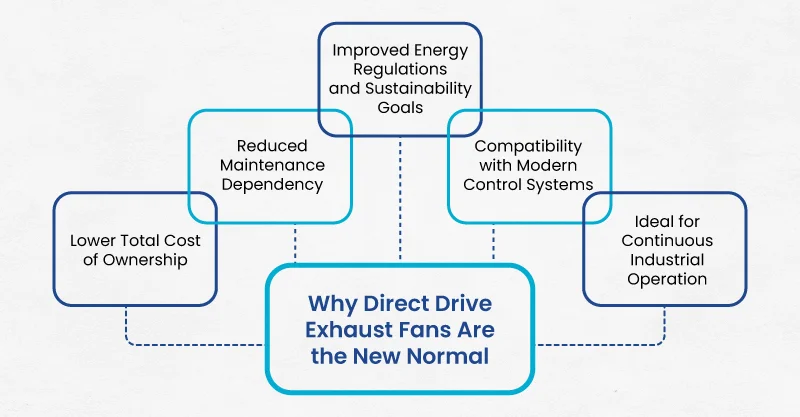
Lower Total Cost of Ownership
Although the initial cost of a direct drive exhaust fan may be slightly higher, the long-term savings in energy and maintenance make it a more cost-effective solution.
Improved Energy Regulations and Sustainability Goals
Modern industries are increasingly focused on energy efficiency and sustainability. Direct drive exhaust fans support these goals by reducing energy consumption and carbon footprint.
Reduced Maintenance Dependency
Industries now prefer solutions that minimise maintenance intervention. Direct drive exhaust fans eliminate frequent belt replacements and align with modern preventive maintenance strategies.
Compatibility with Modern Control Systems
Direct drive exhaust fans integrate easily with VFDs, automation systems, and smart ventilation controls, making them suitable for Industry 4.0 environments.
Ideal for Continuous Industrial Operation
For facilities that require 24/7 ventilation, direct drive exhaust fans offer higher reliability and consistent airflow without performance degradation.
When Belt-Driven Exhaust Fans May Still Be Used
While direct drive exhaust fans are now the preferred choice, belt-driven exhaust fans may still be suitable for:
- Applications requiring frequent speed changes without VFDs
- Very high-temperature environments where motor isolation is required
- Certain legacy systems or retrofit projects
However, even in these cases, modern direct drive solutions are increasingly replacing traditional belt driven designs.
Why KRISSVENT Recommends Direct Drive Exhaust Fans
KRISSVENT designs industrial exhaust fans that align with modern ventilation demands. Our direct drive exhaust fans offer:
- High airflow with superior energy efficiency
- Low maintenance and long service life
- Robust construction for industrial use
- Quiet and vibration-free operation
- Compliance with modern safety and efficiency standards
You may like to read this: What is a direct drive and belt-driven exhaust fan
FAQs
1. Are direct-drive exhaust fans better than belt-driven fans?
2. Do direct drive exhaust fans require less maintenance?
3. Are belt-driven exhaust fans outdated?
4. Can direct drive exhaust fans handle industrial loads?
5. Which exhaust fan is right for my facility?
Conclusion
The shift from belt-driven to direct drive exhaust fans reflects the evolution of industrial ventilation toward efficiency, reliability, and low maintenance. While belt-driven fans served industries well in the past, direct drive exhaust fans are now the new normal, meeting the demands of modern industrial environments.
By choosing KRISSVENT direct drive exhaust fans, industries invest in a future-ready ventilation solution that delivers performance, efficiency, and long-term value.