+91-7624021071
 Download Brochure
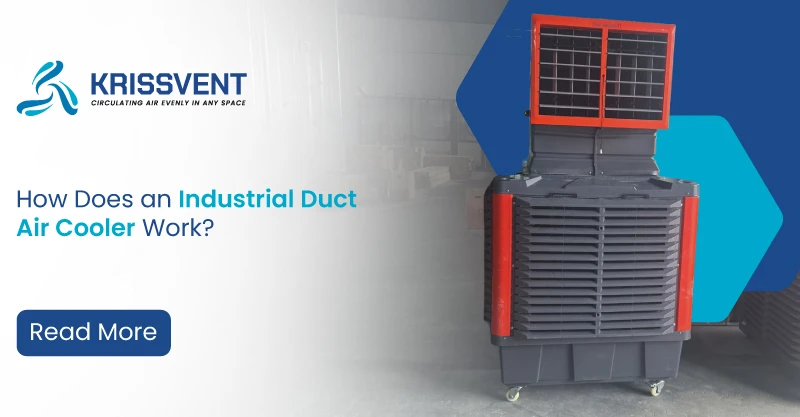
Walk into any large factory in summer – a textile unit, an auto workshop, a packaging plant – and you will feel it immediately. The heat builds up quickly, the air gets heavy, and after a few hours, even experienced workers start to slow down. Managing this heat is not just about comfort. It directly affects productivity, worker health, and the quality of what gets produced on the floor.
An industrial duct air cooler is one of the most practical and cost-effective solutions that factories across India use to solve this problem. But many people, even those looking to buy one, are not entirely sure how it works. What happens inside the machine? Why does it cool better than a regular fan? And is it really different from an air conditioner?
This guide breaks it all down in plain language. No technical jargon, no complex engineering terms. Just a clear explanation of how an industrial duct air cooler works, what its parts do, and why it is the right cooling choice for large industrial spaces.
What is an Industrial Duct Air Cooler?
An industrial duct air cooler is a heavy-duty cooling machine designed to lower the temperature of large, open, or semi-open spaces. It works on a natural process called evaporative cooling — the same principle that makes you feel cooler when a wet cloth is placed on your forehead.
Unlike a regular air conditioner that recirculates the same air inside a closed room, an industrial duct air cooler pulls in fresh outside air, cools it down using water-soaked pads, and then pushes that cool air into the workspace through a duct (a large pipe or channel). This constant supply of fresh, cool air makes it ideal for factories, warehouses, workshops, and any large space where keeping doors and windows open is normal.
The word “duct” simply refers to the channel through which cool air travels from the cooler to different parts of the workspace. This allows a single cooler to distribute cool air across a much wider area than a standard cooler can.
How Does an Industrial Duct Air Cooler Work? (Step-by-Step)
The working process is straightforward. Here is what happens every time the machine is switched on:
| Step | What Happens |
|---|---|
| 1 | Hot outside air is drawn into the cooler through an inlet opening, powered by a strong blower fan inside the machine. |
| 2 | This hot air passes through thick cooling pads (also called cellulose pads or honeycomb pads) that are kept continuously wet by a water distribution system. |
| 3 | As the hot air moves through the wet pads, water absorbs the heat from the air and evaporates. This drops the air temperature by 10 to 15 degrees Celsius or more. |
| 4 | The now-cool, fresh air is pushed by the blower into the duct connected to the cooler. |
| 5 | Cool air travels through the duct and exits through outlets placed at key points across the workspace, covering a large area evenly. |
The key thing to understand is that this is not a recycling process. The cooler is always bringing in new outside air, cooling it, and pushing it in. At the same time, warm, stale air naturally exits through open windows, doors, or exhaust fans. This constant air exchange is what keeps the workspace fresh, not just cool.
Key Parts of an Industrial Duct Air Cooler
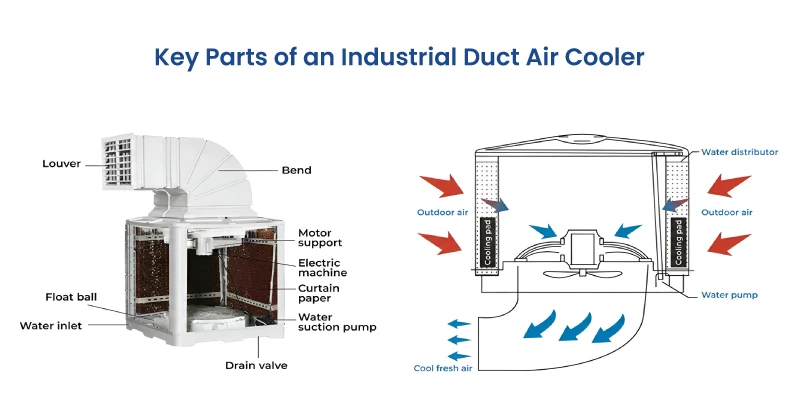
Understanding what is inside the machine helps you know what to look for when choosing one and how to maintain it. An industrial duct air cooler has five main components:
Blower Fan
This is the engine of the cooling system. A powerful blower fan draws hot air in from outside and pushes the cooled air through the duct. In heavy-duty industrial coolers like those from KRISSVENT, the fan motor is built for long hours of continuous operation without overheating.
Cooling Pads
These are thick, specially designed pads made of cellulose or honeycomb material. They have a high surface area, which means water spreads across them evenly and air gets maximum contact with the wet surface. The more surface contact there is, the more heat gets absorbed during evaporation. Good quality cooling pads last longer and require less maintenance.
Water Distribution System
A pump continuously supplies water from a tank to the top of the cooling pads. The water trickles down evenly across the pad surface, keeping it wet at all times. KRISSVENT uses an open-type water distributor that prevents clogging, which is a common problem in cheaper coolers that use enclosed distribution tubes.
Water Tank
The storage tank at the bottom holds the water that the pump circulates. Industrial models have larger tanks so they can run for extended periods without needing a refill. Most units also support direct water line connections, which means the tank refills automatically and the machine runs uninterrupted.
Duct Outlet
The duct is the channel attached to the cooler’s outlet. It directs cool air to exactly where it is needed. Depending on the layout of the workspace, the duct can be a straight pipe, a branched system, or fitted with adjustable vents to control airflow direction and coverage.
How is Duct Cooling Different from Direct Cooling?
This is one of the most common questions people ask before buying an industrial cooler. Here is a simple comparison:
| Feature | Duct Cooler | Direct Cooler |
|---|---|---|
| Air delivery method | Cool air travels through a duct and reaches different zones | Cool air blows directly out of the front of the machine |
| Coverage area | Large — can cover 3,000 to 10,000+ sq. ft. depending on duct layout | Smaller — covers the area directly in front of the machine |
| Best suited for | Large factories, warehouses, production halls, textile units | Workshops, small garages, open event spaces, smaller areas |
| Installation | Fixed installation with duct piping attached to ceiling or walls | Mobile or wall-mounted, no duct piping needed |
| Air distribution | Uniform cooling across the entire workspace | Concentrated cooling in a specific direction |
| Flexibility | Fixed once installed, ideal for permanent large-space setups | Easy to move or reposition |
A duct cooler is the right choice when your workspace is large and you need consistent cooling across the entire floor area. If you only need to cool one corner of a workshop or a smaller space, a direct cooler is simpler and more flexible.
Why Does Evaporative Cooling Work So Well in Large Spaces?
Evaporative cooling has one major advantage in large or semi-open industrial spaces: it does not need a closed environment to work.
A conventional air conditioner works by cooling and recirculating the same air within a sealed room. The moment you open a door or a window, the cool air escapes and efficiency drops sharply. This is why ACs are impractical and expensive to run in factories where doors, windows, and loading docks are frequently open.
An industrial duct air cooler, on the other hand, works best when there is air movement. It keeps pulling in fresh air, cooling it, and pushing it through the space. Open doors and windows actually help because they let the warm air exit, making room for more cool air to flow in. The cooling is continuous, not dependent on a sealed environment.
In a country like India, where summer temperatures routinely cross 40 degrees Celsius in industrial zones, and where large factories simply cannot be sealed like office spaces, this is a critical advantage. Evaporative cooling delivers measurable temperature drops at a fraction of the electricity cost of air conditioning.
What Types of Spaces Benefit the Most from Duct Air Coolers?
Industrial duct air coolers are not a one-size-fits-all solution, but they are the best fit for a wide range of large industrial environments. Here are the spaces where they deliver the most value:
- Textile and garment manufacturing units
- Automobile workshops and assembly plants
- Warehouses and logistics centres
- Food processing units
- Metal fabrication and welding workshops
- Packaging plants and assembly lines
- Event halls and exhibition spaces
If your space has a high ceiling, is frequently open to the outside, runs heavy machinery, or has a large number of workers spread across a wide floor area, a duct air cooler from KRISSVENT is worth serious consideration.
You May Like to Read This: What is an Industrial Cooler? A Complete Guide
FAQs
1. How does an industrial duct air cooler reduce temperature?
2. Is an industrial duct cooler different from a regular air conditioner?
3. How much area can a single industrial duct air cooler cover?
4. Can an industrial duct cooler work in a fully open factory?
5. How much electricity does an industrial duct air cooler consume compared to AC?
6. What maintenance does an industrial duct air cooler require?
7. How long does it take to feel the cooling effect after switching on the cooler?
Ready to Beat the Heat in Your Factory?
KRISSVENT designs and manufactures heavy-duty industrial air coolers for factories, warehouses, and large production spaces across India. Whether you need a duct cooler, a wall-mounted unit, or a mobile solution, the team can guide you to the right fit.
 +91-7624021071
Final Thoughts
An industrial duct air cooler works by doing something simple and natural: it uses water to take the heat out of hot air and then moves that cool air exactly where it is needed. No refrigerant chemicals, no sealed rooms, no sky-high electricity bills.
For large factories, warehouses, and production units across India, it is the most practical and cost-effective way to keep workers comfortable and operations running efficiently through the summer months.
If you are evaluating cooling options for your facility or looking to upgrade what you currently have, understanding how the machine works is the first step. The next step is getting the right unit and configuration for your specific space.
KRISSVENT’s industrial air coolers – available in both mobile and wall-mounted versions — are engineered for demanding industrial environments. Explore the full range and get in touch with the team for a recommendation suited to your space.