+91-7624021071
 Download Brochure
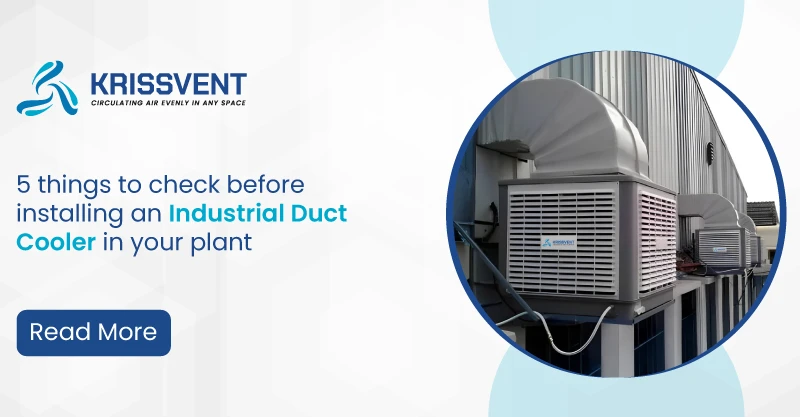
When summer heat starts affecting your factory floor, worker comfort, and machine performance, installing an industrial duct cooler becomes a practical solution.
But many businesses make one common mistake – they purchase the cooler first and think about installation later.
This often leads to poor cooling, high electricity bills, maintenance problems, and unnecessary operational costs.
An industrial duct cooler is not just a cooling machine. It is part of your plant’s ventilation and productivity system. If planned correctly, it can improve working conditions, reduce heat stress, and help maintain better production efficiency.
At KRISSVENT, we help industries choose the right industrial air cooling solutions based on actual site requirements, not just product size.
Before installing an industrial duct air cooler, here are 5 important things to check.
What is an Industrial Duct Cooler?
An industrial duct cooler is a heavy-duty air cooling system designed for large industrial and commercial spaces like factories, warehouses, workshops, production units, and storage facilities.
It works using evaporative cooling technology. Hot air passes through cooling pads, where it gets cooled naturally and is then supplied through ducts to different parts of the plant.
Compared to traditional air conditioning, industrial coolers consume much less electricity and are more practical for large open spaces. KRISSVENT industrial air coolers are designed to deliver high air volume output, better air circulation, and lower running costs.
Why Proper Planning Before Installation Matters
Many plants focus only on buying the biggest cooler available.
But cooling performance depends more on planning than on size.
A properly installed industrial duct cooler helps in:
- Better airflow across the entire plant
- Lower operating and electricity costs
- Improved worker comfort and productivity
- Reduced machine overheating
- Longer equipment life
- Easier maintenance and servicing
Wrong installation can create dead cooling zones, uneven airflow, and frequent repair issues.
That is why pre-installation checks are critical.
1. Check Your Plant Size and Cooling Area
The first step is understanding how much area actually needs cooling.
Not every section of your plant may require the same cooling intensity.
For example:
| Area Type | Cooling Requirement |
|---|---|
| Production Floor | High |
| Packaging Area | Medium |
| Warehouse Storage | Medium |
| Loading Zone | Low |
| Office Section | Separate Requirement |
You should calculate:
- Total floor area
- Ceiling height
- Heat generated by machines
- Number of workers
- Open and closed sections
- Existing ventilation system
A small cooler for a large plant will not work properly.
An oversized system can increase unnecessary energy consumption.
The goal is balanced cooling, not maximum cooling.
2. Review Duct Layout and Air Distribution
This is one of the most ignored factors.
Even a powerful cooler will fail if duct planning is poor.
The duct system decides how effectively cool air reaches every working zone.
You should check:
- Duct length
- Number of bends
- Air outlet positions
- Air throw distance
- Return air movement
- Dead airflow zones
Poor duct design causes:
- Uneven cooling
- Pressure loss
- Higher motor load
- Poor worker comfort
A good duct layout ensures cool air reaches where it is actually needed.
This improves both cooling efficiency and power savings.
3. Confirm Proper Water Supply and Drainage
Industrial coolers depend on water for evaporative cooling.
Without proper water supply planning, cooling performance drops quickly.
Before installation, check:
- Continuous water availability
- Water pressure
- Water quality
- Drainage outlet
- Overflow management
Hard water can create scaling on cooling pads and reduce performance over time.
Improper drainage can lead to leakage and maintenance issues.
KRISSVENT industrial coolers are designed for smooth water distribution and efficient cooling performance, but site preparation is equally important.
4. Ensure Enough Space for Maintenance Access
Many companies install coolers in places where future servicing becomes difficult.
This creates major problems later.
Always keep enough access space for:
- Cooling pad cleaning
- Motor inspection
- Water tank maintenance
- Pump servicing
- Belt and component checks
- Seasonal maintenance
Easy maintenance means:
- Lower service costs
- Less downtime
- Better cooling performance
- Longer machine life
A cooler that is difficult to service becomes expensive over time.
Installation should always consider long-term maintenance, not just short-term placement.
5. Evaluate Energy Consumption and Operating Cost
Cooling should reduce operational stress, not increase electricity bills.
Before selecting an industrial duct cooler, check:
- Motor efficiency
- Air delivery capacity
- Power consumption
- Water consumption
- Running hours per day
- Seasonal usage pattern
Many businesses compare only the purchase price.
Smart buyers compare total operating cost.
KRISSVENT industrial air coolers are designed to provide high airflow while consuming significantly less energy than traditional cooling systems, making them a cost-effective long-term solution.
Quick Pre-Installation Checklist
Before You Finalize Your Industrial Duct Cooler
- Plant area measurement done
- Heat load checked
- Duct layout reviewed
- Water source confirmed
- Drainage planned
- Maintenance access available
- Power consumption evaluated
- Future expansion considered
This simple checklist can save major repair and redesign costs later.
Where Industrial Duct Coolers Work Best
Industrial duct coolers are commonly installed in:
- Manufacturing plants
- Warehouses
- Textile units
- Food processing plants
- Pharmaceutical units
- Engineering workshops
- Assembly units
- Commercial halls
- Large storage areas
These spaces require continuous cooling without the high cost of central AC systems.
You may like to read this: How Does an Industrial Duct Air Cooler Work?
Why Industries Choose KRISSVENT Industrial Coolers
KRISSVENT is a trusted industrial ventilation and cooling solutions provider for factories and large commercial spaces.
Our heavy-duty industrial coolers offer:
- High air volume output
- Energy-efficient cooling system
- Mobile and wall-mounted options
- Low maintenance
- Durable heavy-duty construction
- Reliable long-term performance
We help businesses choose the right cooling system based on plant layout, ventilation needs, and operating goals—not just product size.
Want the Right Industrial Duct Cooler for Your Plant?
Get the right cooling solution for better airflow, lower energy costs, and improved workplace comfort. KRISSVENT helps you choose the best industrial duct cooler for your factory, warehouse, or production unit.
 +91-7624021071
FAQs
1. Is an industrial duct cooler better than air conditioning for factories?
2. How do I choose the right size industrial cooler?
3. Does duct layout affect cooling performance?
4. How much maintenance does an industrial cooler require?
5. Can industrial coolers work in open factory spaces?
Conclusion
Installing an industrial duct cooler is not just about buying equipment.
It is about creating a smarter cooling system for your plant.
If you check the right factors before installation, you get:
better cooling, lower running costs, improved worker comfort, and stronger operational efficiency.
If you skip planning, even the best cooler may fail to deliver results.
At KRISSVENT, we help industries make the right cooling decisions with practical, high-performance industrial air cooling solutions built for real factory conditions.
Before you install your next industrial duct cooler, make sure you check these 5 essentials first.