+91-7624021071
 Download Brochure
A fabrication factory in May is one of the hottest workplaces in India. The shed traps heat under a metal roof, every arc adds more, freshly welded parts radiate like heaters, and workers do it all in flame-resistant jackets, gloves, and helmets.
Air conditioning is out of the question in a plant full of sparks, fumes, and open shutters. But the wrong fan is also a problem, because a strong draft across a weld can blow away the shielding gas and ruin the joint.
So the real question isn’t just “how do we cool the factory.” It’s “how do we cool the factory without compromising weld quality.” Here are the three options that do both, and how to combine them.
Why Fabrication Factories Get Hotter Than Other Plants
Cooling Options for Welding Factories in India | KRISSVENT
- Metal roofs and walls absorb solar heat and radiate it inward all afternoon
- Every welding arc, plasma cutter, and furnace adds heat at floor level
- Finished workpieces stay hot for hours, warming the air around them
- Welders wear heavy PPE that blocks the body’s own cooling
- Shutters stay open for material movement, so cooled air never stays in
Heat stress in this environment is a safety issue, not a comfort issue. Tired, overheated welders make more errors, and errors in fabrication are expensive.
The Rule That Decides Everything: Protect the Shielding Gas
MIG and TIG welding depend on a shield of gas around the molten weld pool. Even a light breeze across the arc can disperse that shield and cause porosity, tiny gas pockets that weaken the weld and fail inspection.
This is why generic high-speed fans pointed at welders often create more problems than they solve. The industry answer is variable speed control: airflow strong enough to cool people, gentle enough at the arc to leave the gas shield alone.
Keep this rule in mind as you read the options below. All three work in a welding facility precisely because their speed can be tuned, not just switched on.
The 3 Best Cooling Options for Welding & Fabrication Factories
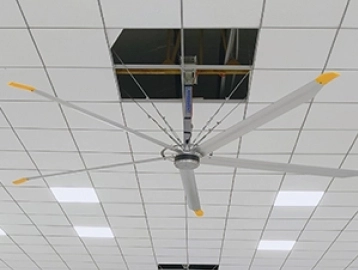
1. HVLS Fans: Whole-Floor Cooling Without the Blast
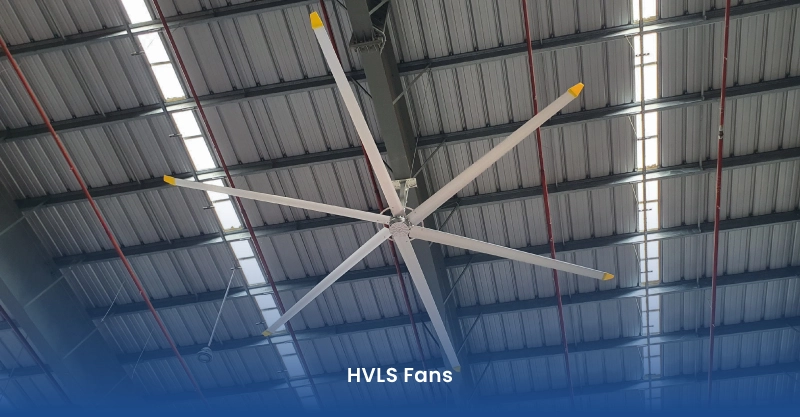
HVLS fans are the opposite of a blower. A blade span of 8 to 24 feet turning slowly moves a huge volume of air as a gentle, even breeze across the entire production floor, making workers feel 4 to 6°C cooler.
Why they suit fabrication plants:
- Air arrives as low-velocity flow, far less likely to disturb an arc than a jet from a spot fan
- One fan covers up to 1,700 sq. m, so a mid-size factory needs only one or two
- Stepless PMSM speed control from 0 to full lets you find the exact airflow your welding bays tolerate
- Runs on 0.3 to 1.8 kW at 38 dB or less, so it costs little and you’ll barely hear it
Best for: the main fabrication hall, assembly and fit-up areas, and plants that want one system covering everyone.
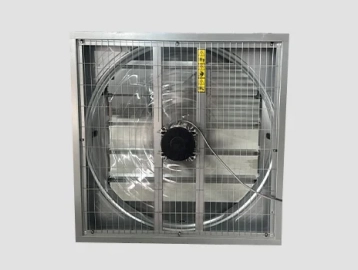
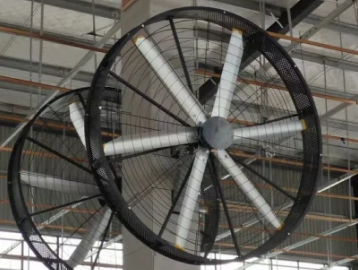
2. Industrial Wall Fans: Fixed Airflow for Fixed Workstations
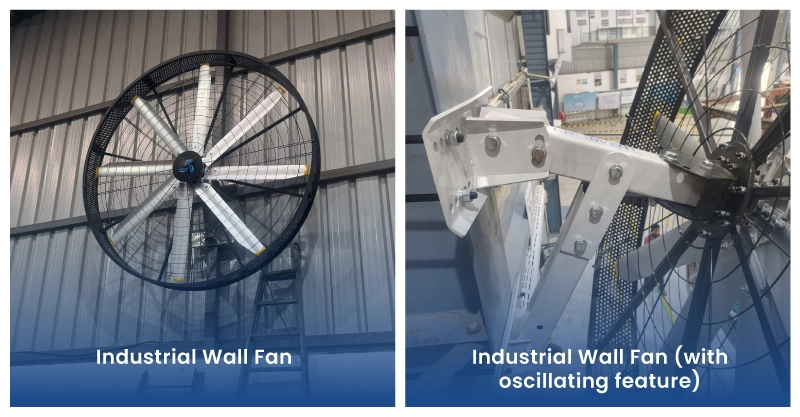
Wall-mounted industrial fans deliver directed air to specific zones without taking any floor space, which matters in factories where every square metre holds material, machines, or trolleys.
- The 2-metre PMSM wall fan moves 6,636 m³/min on just 0.3 kW, at 38 dB
- Oscillating models sweep air across a bay with a 20-metre throw
- Stepless speed from 5 to 240 RPM, tuned per station
- Mounted high, away from sparks, grinding dust, and forklift traffic
Best for: grinding and finishing stations, shear and press brake areas, and fixed workstations where the same people work all shift.
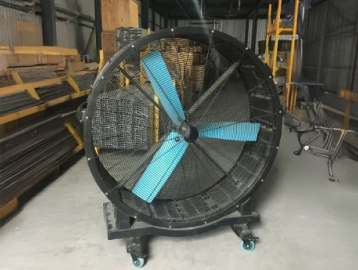
3. Industrial Mobile Fans: Cooling That Follows the Job
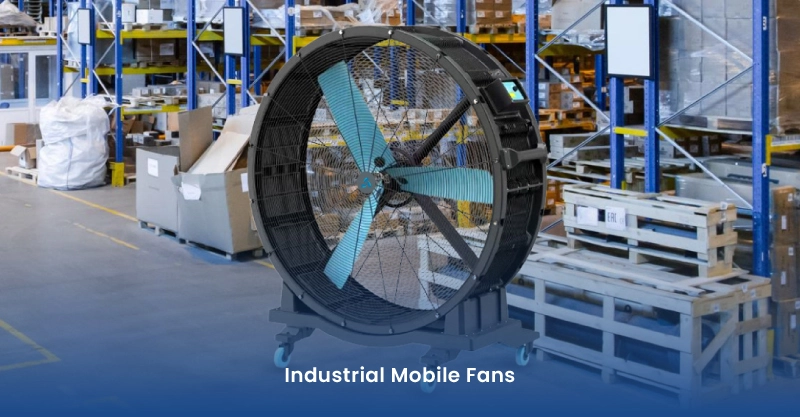
Fabrication work moves around: today’s heavy assembly happens in a different bay than last week’s. Industrial mobile fans move with it.
- The KVS 48 pushes 38,000 m³/h with a 35 to 40 metre throw, on a 600W motor
- The lighter DP-30 covers 200 to 300 sq. m, weighs 20 kg, and one person can reposition it in seconds
- No installation at all: wheel it in, plug it in
- Stepless speed adjustment, so you can drop the velocity near active welding
Best for: spot-cooling large workpieces, temporary work areas, doorway air movement, and rest zones where welders cool down between jobs.
Quick Comparison for Fabrication Factories
| Factor | HVLS Fan | Industrial Wall Fan | Industrial Mobile Fan |
|---|---|---|---|
| Coverage | Up to 1,700 sq. m | Zone / bay (20 m throw) | 200–300 sq. m spot |
| Airflow style | Gentle, whole-floor | Directed, fixed | Directed, movable |
| Floor space used | None (ceiling) | None (wall) | Small footprint |
| Power draw | 0.3–1.8 kW | 0.3–0.75 kW | 0.4–0.6 kW |
| Arc safety | Lowest draft risk | Tune speed + angle | Reposition + tune speed |
| Best role | Base cooling for all | Fixed workstations | Hot spots & moving work |
How to Combine All Three in One Factory
Most fabrication units in India get the best result from layering, not choosing:
- HVLS overhead as the base layer, giving everyone steady, gentle airflow
- Wall fans at grinding, finishing, and machine stations that need stronger directed air
- Mobile fans wherever the hot job is this week, plus at rest areas
Two placement rules protect your welds: never point a fan directly across an active MIG/TIG arc, and use welding screens where high airflow zones sit next to welding bays. For fume-heavy work, pair the fans with exhaust fans so contaminated air actually leaves the building instead of circulating.
Why Fabrication Units Choose KRISSVENT
- Every fan, from 24 ft HVLS to 30-inch mobile, uses PMSM motors with stepless speed control, the single feature welding facilities need most
- ISO and CE certified, built for dusty, high-temperature industrial environments
- 9.9+ million sq. m ventilated across 200+ Indian cities, including clients like Tata Steel and New Holland Agriculture
- Site assessment before quoting, so fan placement respects your welding bays, not just your floor plan
- Pan-India installation and service, covering fabrication belts from Ludhiana to Rajkot to Coimbatore
Is Summer Heat Slowing Down Your Fabrication Floor?
Get a free airflow assessment for your factory. We’ll map welding bays, workstations, and hot spots, then recommend the right mix of HVLS, wall, and mobile fans.
 +91-7624021071
FAQs
1. Can fans blow away shielding gas and cause weld porosity?
2. Which fan is best for a smaller fabrication unit?
3. Are HVLS fans safe in a welding environment?
4. Do these fans remove welding fumes too?
5. Why not use an evaporative cooler in a welding factory?
Conclusion
Cooling a welding factory is a balancing act: enough airflow to keep workers safe through an Indian summer, gentle enough control to keep every weld sound. That balance is exactly what stepless-speed fans deliver.
Use HVLS fans as the base layer, wall fans at fixed stations, and mobile fans wherever the work goes. Keep direct airflow off active arcs, and let exhaust fans handle the fumes.
KRISSVENT supplies all three fan types with PMSM stepless control, and plans the layout around your welding bays before recommending anything. Start with a site assessment.