+91-7624021071

 Download Brochure

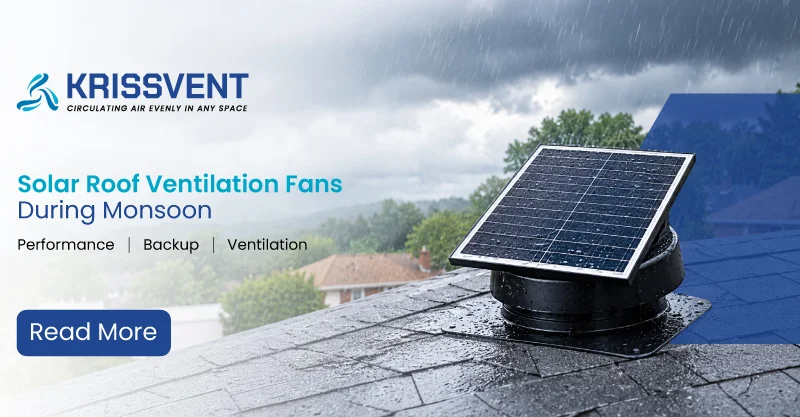
Monsoon conditions can create new ventilation challenges for industrial sheds and factories. While solar roof ventilation fans are commonly used to remove hot air during summer, their performance during cloudy weather, rainfall, and reduced sunlight needs proper planning.
Solar roof ventilation fans during monsoon can still support air circulation and moisture control, but factors such as sunlight availability, rain protection, roof installation, and backup options should be considered before installation.
How Do Solar Roof Ventilation Fans Work During Monsoon?
Solar roof ventilation fans operate using energy generated from solar panels.
During monsoon:
- Solar panels receive less direct sunlight
- Fan speed may vary depending on available solar power
- Cloudy conditions can reduce airflow output
- Rainwater protection becomes important for roof-mounted equipment
Even during overcast conditions, solar fans can continue operating if sufficient solar energy is available.
For factories where continuous ventilation is required regardless of weather conditions, backup options may be considered.
Can Solar Roof Ventilation Fans Work on Cloudy Days?
Yes, but performance can vary.
Solar output depends on:
- Sunlight intensity
- Cloud coverage
- Solar panel efficiency
- Panel orientation
- Weather conditions
During bright sunlight, the fan can operate at higher capacity. During heavy cloud cover, airflow may reduce because the solar panel generates less power.
This makes it important to evaluate whether the factory requires:
- Daytime ventilation only
- Continuous ventilation
- Backup-supported operation
Why is Ventilation Important During Monsoon?
Monsoon increases moisture levels inside industrial sheds.
Poor ventilation can contribute to:
- Higher humidity
- Condensation
- Stale air
- Moisture accumulation
- Discomfort for workers
- Possible impact on stored materials
Solar roof ventilation fans help remove trapped warm and humid air from the upper areas of the shed.
They are commonly considered for:
- Manufacturing units
- Warehouses
- Industrial sheds
- Storage facilities
- Workshops
What Should Be Checked Before Installing Solar Roof Fans for Monsoon?
1. Roof Installation and Waterproofing
Since solar roof ventilation fans are installed directly on the roof, proper installation is essential.
Check:
- Roof sheet condition
- Mounting method
- Waterproof sealing
- Drainage arrangement
- Roof slope
- Rainwater flow direction
Incorrect installation can create leakage risks during heavy rainfall.
2. Solar Panel Position and Orientation
Solar performance depends on panel exposure.
Consider:
- Panel angle
- Shading from nearby structures
- Roof orientation
- Dust and water accumulation
- Regular cleaning access
A well-positioned solar panel improves energy generation throughout the year.
3. Required Ventilation During Cloudy Weather
Not every facility has the same ventilation requirement.
For example:
A warehouse storing moisture-sensitive products may require more consistent ventilation compared to a general workshop.
Before installation, evaluate:
- Operating hours
- Indoor humidity levels
- Heat generation
- Stored materials
- Production processes
Solar Roof Ventilation Fan With Battery Backup vs Without Backup
A major consideration during monsoon is whether the system needs backup power.
| Solar Roof Fan Without Backup | Solar Roof Fan With Backup |
|---|---|
| Operates mainly during sunlight hours | Can operate during low sunlight periods depending on battery capacity |
| Lower initial investment | Higher initial investment |
| Suitable for daytime heat removal | Suitable where continuous ventilation is required |
| Performance depends on weather conditions | Provides additional operational flexibility |
The right option depends on the ventilation requirement of the facility.
Where Should Solar Roof Ventilation Fans Be Installed?
For better performance, fans are generally installed where hot and humid air collects.
Suitable locations include:
- Higher roof sections
- Above heat-generating areas
- Production zones
- Areas with limited natural airflow
- Large enclosed shed sections
For larger factories, multiple roof fans may be distributed across different areas based on airflow requirements.
Can Solar Roof Ventilation Fans Replace Exhaust Fans During Monsoon?
It depends on the application.
Solar roof ventilation fans are useful for removing trapped hot and humid air, especially during daytime operation.
However, facilities requiring:
- Continuous ventilation
- Heavy moisture removal
- Night-time operation
- Process-specific exhaust
may require electrically powered exhaust systems or additional ventilation solutions.
The right choice depends on the factory environment and operating conditions.
What Should You Check Before Monsoon Installation?
Before installing solar roof ventilation fans, check:
- Roof structure and waterproofing
- Solar panel exposure
- Rainwater drainage path
- Required ventilation hours
- Indoor humidity conditions
- Heat-generating equipment
- Backup power requirement
- Maintenance accessibility
Proper planning helps maintain ventilation performance throughout changing weather conditions.
Why Choose KRISSVENT Solar Roof Ventilation Fans?
KRISSVENT provides ventilation solutions for industrial sheds where heat and air circulation management are important.
Fan selection can be planned based on:
- Factory size
- Roof structure
- Ventilation requirement
- Weather conditions
- Operating environment
- Backup requirements
A properly planned solar roof ventilation system helps improve airflow while considering seasonal conditions like summer heat and monsoon humidity.
Planning Solar Roof Ventilation for Your Factory?
Share your shed size, roof type, operating conditions, and ventilation requirement with KRISSVENT to identify a suitable solution.
 +91-7624021071

FAQs
1. Do solar roof ventilation fans work during monsoon?
2. What happens to solar fans on cloudy days?
3. Do solar roof ventilation fans need battery backup?
4. Are solar roof ventilation fans waterproof?
5. Can solar roof ventilation fans reduce humidity inside factories?
Conclusion
Solar roof ventilation fans during monsoon can continue supporting industrial ventilation when the system is planned according to weather conditions, roof design, and operational requirements.
The key considerations are solar performance, waterproof installation, ventilation needs, and backup requirements.
A properly designed system helps factories maintain better airflow through changing seasonal conditions.