+91-7624021071
 Download Brochure
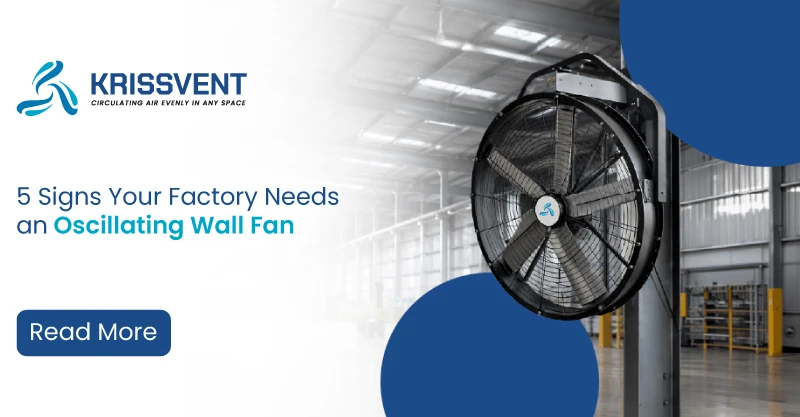
Most factories don’t decide to buy an oscillating wall fan. They decide to fix a symptom: a row of workers complaining about heat, a floor cluttered with pedestal fans, a corner where the air never moves.
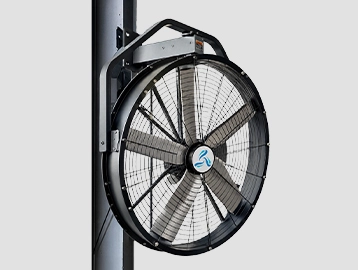
An oscillating wall fan sweeps airflow across a 90 to 120 degree arc from a single wall mount, covering a zone that would otherwise need two or three fans. That one ability solves a specific set of problems.
If you recognise any of the five signs below, your facility is already telling you what it needs.
Sign 1: Some Workstations Get Airflow, Others Sit in Dead Zones
Walk your floor on a hot afternoon. If comfort depends on where someone happens to sit, one bench in a breeze while the next one bakes, your fixed fans are leaving gaps between their throw lines.
A fixed fan covers a straight corridor of air and nothing beside it. An oscillating fan sweeps across the whole row, so every workstation in the arc gets airflow on a steady cycle instead of a lucky few getting all of it.
Sign 2: Pedestal Fans Are Taking Over Your Floor
Count the pedestal fans on your floor. Each one started as a quick fix, and now they occupy working space, trail cables across walkways, get knocked by trolleys, and still leave people hot.
A wall-mounted oscillating fan removes the whole problem: zero floor space, no cables at ground level, nothing for a forklift to hit. One KRISSVENT DB 120 moves 28,000 m³/hr with a 20-metre throw, more than a cluster of pedestal fans combined.
Sign 3: Rows of People, Fans That Point One Way
Packing lines, stitching rows, assembly benches, canteens: wherever people work spread out in lines, a fixed fan faces an impossible choice about who gets the air.
This is the layout oscillating fans were built for. The sweep serves everyone in the arc, and the passing breeze it creates actually feels better than constant wind blasting one position all shift.
Sign 4: Air Feels Stale and Odours Hang Around
Stagnant air is more than a comfort problem. In zones where air doesn’t move, humidity pockets form, odours from processes and canteens linger, and the space feels stuffy even when it isn’t hot.
Because an oscillating fan keeps changing direction, it stirs the full zone rather than carving one channel through it. Dead corners get swept on every cycle, which keeps air fresh across the whole area, not just along a line.
Sign 5: Fan Count Keeps Rising, Comfort Doesn’t
If every summer adds more small fans but the complaints stay the same, you’re paying more electricity for the same poor coverage. Five small fans running all shift cost more to run and maintain than one properly placed oscillating wall fan covering the same zone.
Fewer machines also means fewer things to clean, fewer motors to fail, and fewer mounting points, a saving that compounds every year.
What the Right Oscillating Wall Fan Looks Like
If the signs fit, choose the fan on these numbers:
- Airflow: 28,000 m³/hr on the KRISSVENT DB 120, with a 20-metre throw
- Motor: PMSM direct drive with stepless speed control, so you tune airflow to the zone instead of living with two fixed settings
- Noise: under 45 dB, quiet enough for continuous running near workers
- Build: aerofoil aluminium-magnesium alloy blades with efficiency above 95%, made for multi-shift industrial duty
Still weighing oscillating against fixed? Read our full comparison: Oscillating vs Fixed Wall Fan
Why Factories Choose KRISSVENT Wall Fans
- Industrial Oscillating and fixed wall fans under one roof, both PMSM-driven
- ISO and CE certified, built for dusty, hot Indian factory conditions
- 9.9+ million sq. m ventilated across 200+ cities
- Placement planned around your work rows and dead zones, not just available wall space
- Pan-India installation and after-sales support
Seeing These Signs on Your Factory Floor?
Book a free site assessment. We’ll map your dead zones and work rows, then show you exactly where one oscillating fan replaces three quick fixes.
 +91-7624021071
FAQs
1. How much area does one oscillating wall fan cover?
2. Where should an oscillating wall fan be installed in a factory?
3. Can an oscillating wall fan run continuously through multiple shifts?
4. Do oscillating wall fans work in dusty factory environments?
5. How many pedestal fans can one oscillating wall fan replace?
Conclusion
Dead zones between workstations, a floor full of pedestal fans, rows of people fighting over one air line, stale corners, and a growing fan count with flat comfort: each sign points to the same gap. Your airflow doesn’t sweep, and your floor layout needs it to.
One oscillating wall fan per zone usually closes that gap. KRISSVENT will map your floor free of charge and tell you where, and where a fixed fan or HVLS fan is honestly the better fit instead.