+91-7624021071
 Download Brochure
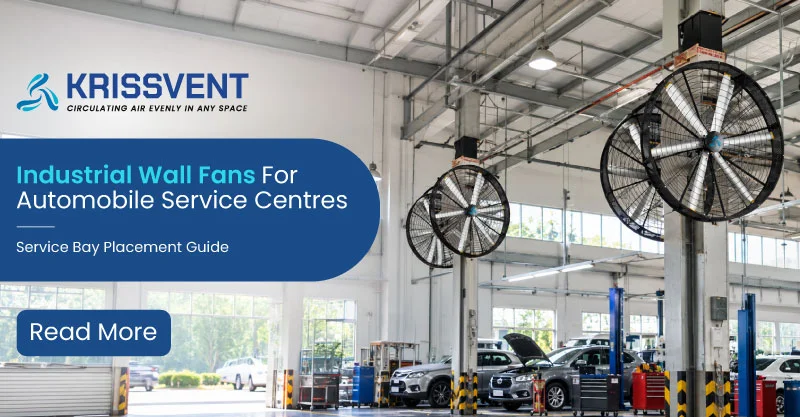
Automobile service centres can become hot and uncomfortable because of vehicle engines, equipment, lighting, limited natural airflow, and constant movement across multiple service bays.
Industrial wall fans for automobile service centres help improve air circulation without occupying floor space, making them useful around workshops, garages, and vehicle service bays.
The main challenge is placement. A wall fan should support airflow around technicians and work areas without blowing directly into sensitive operations, creating dust problems, or interfering with vehicle movement.
Why Use Industrial Wall Fans in Automobile Service Centres?
Industrial wall fans are suitable for service centres because they can provide focused airflow while keeping the floor clear.
They can help:
- Improve airflow around service bays
- Reduce stagnant hot zones
- Support technician comfort
- Keep floor space free for tools and vehicles
- Cover work areas where ceiling fan installation is difficult
- Support overall workshop ventilation
They are especially useful where work zones are arranged along perimeter walls.
Where Should Wall Fans Be Placed Around Service Bays?
Wall fans should be positioned to move air across the working zone, not directly into technicians’ faces or vehicle components.
Typical locations include:
- Between adjacent service bays
- On side walls facing the working area
- Near high-heat work zones
- Along long workshop walls
- Near inspection or repair stations
The objective is to create useful cross-air movement without disturbing tools, paperwork, dust, or workshop operations.
How High Should Industrial Wall Fans Be Installed?
The fan should be mounted high enough to remain clear of:
- Vehicle roofs
- Raised cars on lifts
- Tool cabinets
- Shelving
- Electrical panels
- Workshop equipment
- Technician movement
At the same time, it should still direct airflow toward the occupied work zone.
The final mounting height depends on the wall height, service bay layout, and fan size.
One Fan per Service Bay or Shared Coverage?
Not every service bay necessarily needs a separate wall fan.
A single fan may work when:
- Bays are close together
- The fan has a wide oscillation range
- The workshop layout is open
- There are few obstructions
Multiple fans may be better when:
- Bays are separated
- Vehicles block airflow
- The workshop is long
- There are multiple heat-generating work zones
- Technicians work in fixed bay positions
The fan layout should follow the service-bay arrangement rather than using equal spacing automatically.
What Should Be Avoided When Positioning Wall Fans?
Avoid placing fans where airflow may:
- Blow dust directly toward technicians
- Disturb paint or detailing work
- Affect welding or flame-based work
- Blow loose materials across the workshop
- Interfere with exhaust extraction
- Push fumes from one bay into another
- Hit vehicles from an unsuitable direction
Good placement should improve comfort without creating a new operational problem.
Can Wall Fans Be Used With Workshop Ventilation?
Yes.
Industrial wall fans are mainly used for air circulation, while exhaust or fresh-air systems handle air exchange.
A practical setup may combine:
Fresh Air / Exhaust Ventilation + Industrial Wall Fans for Local Air Movement
This can help improve circulation around technicians while maintaining proper workshop ventilation.
What Should You Check Before Installation?
Before installing industrial wall fans in an automobile service centre, confirm:
- Number of service bays
- Bay width and spacing
- Wall height
- Vehicle lift positions
- Tool and equipment locations
- Welding or paint work areas
- Exhaust extraction points
- Technician working positions
- Electrical access
- Maintenance clearance
This helps determine the right fan quantity and mounting positions.
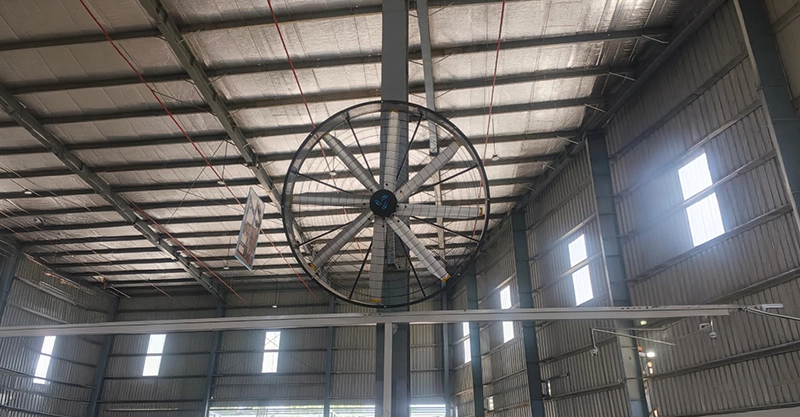
KRISSVENT Industrial Wall Fan Installations in Automobile Workshops
Why Choose KRISSVENT Industrial Wall Fans for Service Centres?
KRISSVENT industrial wall fans can be used in automobile workshops and service centres where strong local air circulation is required without using floor-mounted equipment.
Fan placement can be planned according to:
- Service bay arrangement
- Workshop dimensions
- Mounting height
- Required airflow direction
- Equipment layout
- Number of technicians
- Existing ventilation system
Rather than placing fans at fixed intervals, KRISSVENT can help identify positions that provide useful airflow around active service areas.
Planning Airflow Around Your Service Bays?
Share your workshop dimensions, number of service bays, and wall layout with KRISSVENT to identify suitable wall fan positions.
 +91-7624021071
FAQs
1. Where should industrial wall fans be installed in an automobile service centre?
2. How many wall fans does a service centre need?
3. Can one wall fan cover two service bays?
4. Can industrial wall fans be used near vehicle lifts?
5. Are wall fans enough for workshop ventilation?
Conclusion
Industrial wall fans for automobile service centres work best when their placement follows the actual service-bay layout.
The main factors are bay spacing, mounting height, vehicle lifts, technician positions, equipment, and existing ventilation.
Correct placement can improve airflow around technicians while keeping workshop floors clear and service operations uninterrupted.