+91-7624021071
 Download Brochure
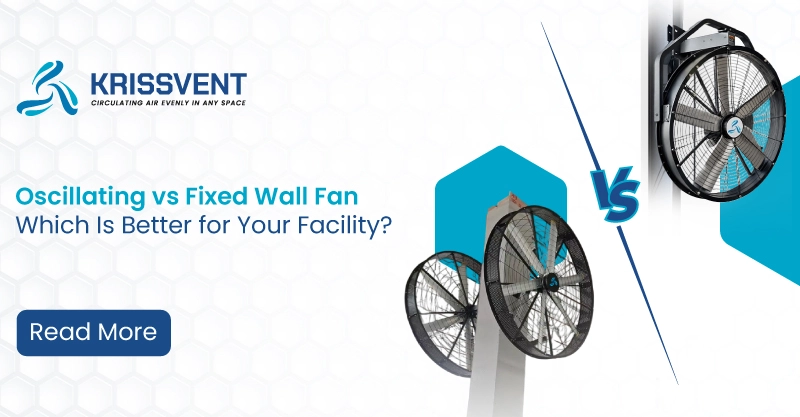
The short answer: an oscillating industrial wall fan is better when people are spread across a wide area, because its sweeping motion covers a 90 to 120 degree arc from a single point. A fixed wall fan is better when you need constant, concentrated airflow on one spot, a hot machine, a workstation row, or a long aisle. Most facilities end up needing both, in different places.
Here’s how the two compare in practice, and how to decide zone by zone.
What Is an Oscillating Wall Fan?
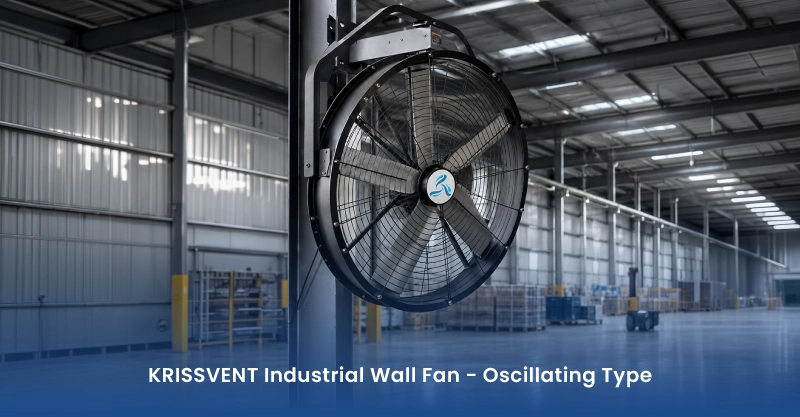
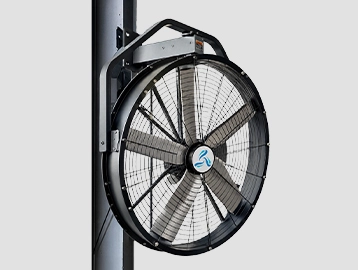
An oscillating wall fan is a wall-mounted fan whose head swings from side to side, sweeping airflow across an arc instead of holding one direction. A model like the KRISSVENT DB 120 delivers 28,000 m³/hr with a 20-metre throw, so one fan serves an area that would otherwise need two or three fans pointed at different angles.
The airflow at any single spot is intermittent: the breeze arrives, passes, and returns a few seconds later. For people, that cycling breeze actually feels more comfortable than constant wind.
What Is a Fixed Wall Fan?
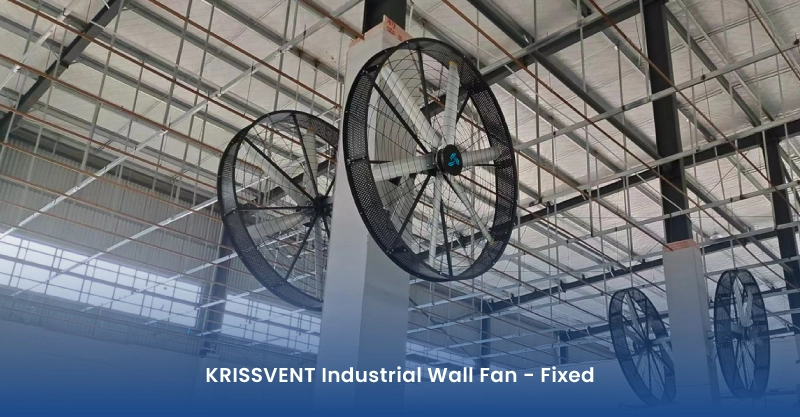
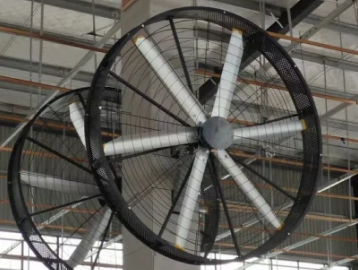
A fixed industrial wall fan points one way and stays there, delivering continuous airflow along a single line. This is where the big industrial models live: the KRISSVENT DB-2.0E has a 2-metre blade span, moves 6,636 m³/min, and draws just 0.3 kW at 38 dB or less, with stepless speed control from 5 to 240 RPM.
Because the airflow never leaves its target, fixed fans suit jobs where the target never moves: cooling equipment, ventilating an aisle, or pushing air through a doorway.
Oscillating vs Fixed Wall Fan: Key Differences
| Factor | Oscillating Wall Fan | Fixed Wall Fan |
|---|---|---|
| Airflow pattern | Sweeps a 90-120° arc | One constant direction |
| Coverage per fan | Wide zone, many workstations | Narrow zone, single target |
| Airflow at each spot | Intermittent (cycling breeze) | Continuous |
| Best cools | People spread across an area | Machines, fixed spots, aisles |
| Moving parts | Fan + oscillation mechanism | Fan only |
| Typical power (KRISSVENT) | 0.75 kW (DB 120) | 0.3 kW (DB-2.0E) |
| Noise | <45 dB | ≤38 dB |
When Is an Oscillating Wall Fan Better?
Choose oscillating when the airflow has to serve many positions from one mounting point:
- Rows of workstations, packing tables, or assembly benches
- Gyms, canteens, and halls where people are spread out
- Wide zones where mounting several fixed fans would cost more and clutter the walls
- Comfort cooling, where the cycling breeze feels better than constant wind
One oscillating fan covering an arc often replaces two or three fixed fans, which means fewer mounting points, fewer cables, and less to maintain.
When Is a Fixed Wall Fan Better?
Choose fixed when the target is specific, and the airflow must never pause:
- Cooling a hot machine, panel, or process point where intermittent airflow lets heat rebuild
- Long, narrow spaces like aisles and corridors, where one straight throw covers everything
- Creating a steady air path from inlet to exhaust for ventilation
- Maximum efficiency: a large fixed fan like the DB-2.0E moves enormous air volume on 0.3 kW because nothing is spent on sweeping a mechanism side to side
Which One Should You Choose?
Answer one question per zone: Does the airflow target move or spread?
- People spread across a wide area → oscillating
- One fixed hot spot, machine, or aisle → fixed
- Very large open floor with high ceilings → consider an HVLS fan as the base layer, with wall fans filling the zones it can’t reach
- Both situations in one building → mix them; that’s what most facilities we assess end up doing
There is no single winner. The facilities that get cooling right match the airflow pattern to each zone instead of standardizing on one fan type.
You may like to read this: Industrial Wall Fan vs Pedestal Fan: Which Is Better for Factory Cooling?
Why Industries Choose KRISSVENT Wall Fans
- Both types under one roof: the DB 120 oscillating and the 2-metre DB-2.0E fixed, each with PMSM motors and stepless speed control
- Aerofoil aluminium-magnesium alloy blades with efficiency above 95%
- Quiet enough for continuous running: 38 to 45 dB across the range
- 9.9+ million sq. m ventilated across 200+ Indian cities
- Site assessment first, so each zone gets the right fan type, not a one-size order
 +91-7624021071
FAQs
1. What is the main difference between an oscillating and a fixed wall fan?
2. Is an oscillating wall fan better for cooling workers?
3. Can one oscillating wall fan replace multiple fixed fans?
4. Do oscillating wall fans need more maintenance than fixed ones?
5. Which uses more electricity, an oscillating or a fixed wall fan?
Conclusion
Oscillating or fixed comes down to what the airflow serves. People spread across a zone want the sweep of an oscillating fan. Machines, aisles, and fixed hot spots want the constant push of a fixed fan. Buildings almost always contain both situations, so the right order is usually a mix.
KRISSVENT manufactures both types with PMSM stepless control and will map your zones before recommending either. Start with a site assessment.