+91-7624021071
 Download Brochure
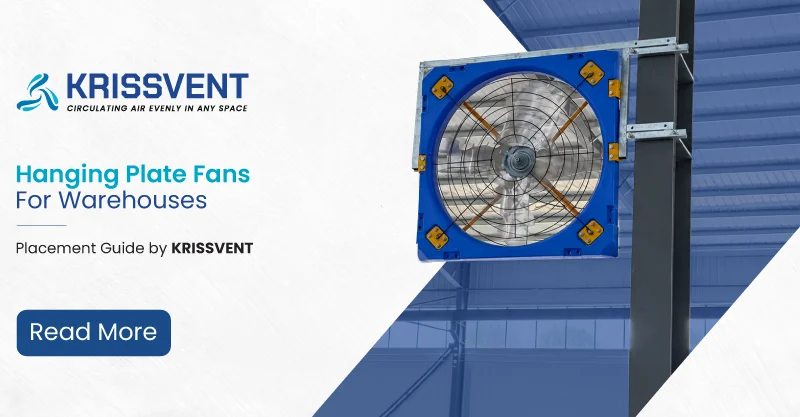
Warehouses with tall storage racks often have a different airflow problem from open industrial floors. Racks can block horizontal air movement, while long aisles may develop warm or stagnant zones.
Hanging plate-type fans for warehouses can provide strong directional airflow without taking up floor space. The main challenge is deciding where to position them so air moves through aisles instead of being blocked by racks, beams, or stored goods.
Why Use Hanging Plate-Type Fans in Warehouses?
Hanging plate-type fans are useful where targeted airflow is required from an overhead position.
They can help:
- Move air through long warehouse aisles
- Improve airflow around workers and picking zones
- Reduce stagnant areas between rack rows
- Keep floor space clear for forklifts and material movement
- Provide focused airflow where large ceiling fans may not be suitable
- Support existing warehouse ventilation systems
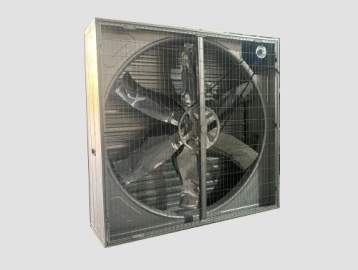
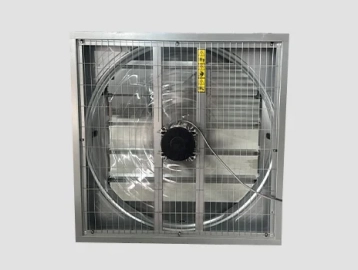
KRISSVENT’s KVS-1140 Hanging Plate Type Fan has a 1000 mm blade diameter and a published air volume of 32,500 m³/h, making it suitable for strong local air circulation in warehouses and similar industrial spaces.
Where Should Hanging Plate Fans Be Positioned Around Racks?
The fan should be positioned so the airflow has a clear path through the working area.
Good locations can include:
- Above the entrance of long aisles
- At aisle intersections
- Between rack zones
- Above picking and packing areas
- Near loading or staging sections
- In areas where racks restrict cross-airflow
The aim is to send air along the aisle rather than directly into the side of a storage rack.
Simple Positioning Principle
Fan → Clear Aisle → Working Area
Instead of:
Fan → Storage Rack → Blocked Airflow
This small difference in placement can have a major effect on how useful the fan feels at floor level.
Should Fans Blow Along or Across Warehouse Aisles?
In most rack-heavy warehouse layouts, directing airflow along the aisle is more practical.
Air travelling along an open aisle can reach further before encountering an obstruction. Air directed across several rack rows is more likely to be interrupted by pallets, cartons, and rack structures.
| Placement | Expected Airflow |
|---|---|
| Along aisle | Better directional reach |
| Directly toward rack | Airflow becomes obstructed |
| At aisle intersection | Can support multiple adjacent zones |
| Above picking area | Provides focused worker-level circulation |
| Between dense rack rows | Requires careful direction and clearance |
The best orientation depends on rack height, aisle width, fan mounting height, and stored material.
How High Should a Hanging Plate Fan Be Installed?
KRISSVENT states that its Hanging Plate Type Fan is ideally installed at around 6 metres, where it can maintain an air speed of approximately 4.5–5.0 m/s.
However, actual mounting height should also consider:
- Rack height
- Roof structure
- Sprinkler systems
- Lighting
- Forklift mast height
- Stored material height
- Required airflow at working level
The fan should have sufficient clearance while still directing useful airflow toward occupied zones.
How Many Fans Does a Warehouse Need?
Fan quantity should not be decided only by warehouse floor area.
Consider:
- Number and length of aisles
- Rack height
- Width of each aisle
- Fan airflow capacity
- Mounting height
- Obstructions
- Picking or packing activity
- Existing ventilation
A warehouse with several long isolated aisles may need more strategically placed fans than an open warehouse of the same area.
What Should Be Avoided When Positioning Fans?
Avoid installing hanging plate-type fans where airflow is immediately blocked.
Common placement mistakes include:
- Facing directly into high racks
- Installing too close to roof beams
- Positioning above areas with no occupied work zone
- Blowing lightweight packaging or loose material
- Interfering with sprinklers or lighting
- Creating airflow conflicts between multiple fans
- Installing within forklift or material-handling clearance zones
The objective is useful air movement through the warehouse, not simply maximum fan quantity.
Can Hanging Plate Fans Work With Other Warehouse Fans?
Yes.
Different warehouse zones can require different airflow solutions.
For example:
- Hanging plate-type fans for long aisles and focused circulation
- HVLS fans for large open warehouse areas
- Industrial wall fans for perimeter workstations
- Exhaust fans for removing hot or stale indoor air
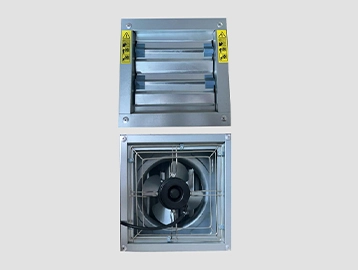
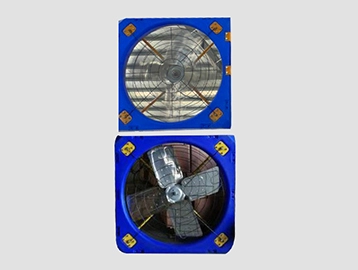
KRISSVENT’s own gallery includes warehouse projects using multiple fan types, including HVLS, wall, and exhaust fan installations.
What Should You Check Before Installation?
Before installing hanging plate fans around warehouse racks, confirm:
- Warehouse length and width
- Rack height and orientation
- Aisle width and length
- Fan mounting height
- Forklift movement
- Picking and packing zones
- Sprinkler locations
- Lighting and roof beams
- Electrical access
- Existing ventilation
A rack layout drawing can make fan placement much easier to plan.
Why Choose KRISSVENT Hanging Plate-Type Fans?
KRISSVENT’s KVS-1140 is designed for overhead industrial air circulation, with published specifications including:
- 1000 mm blade diameter
- 32,500 m³/h air volume
- 700 RPM
- 0.55 kW power
- 415 V operation
- 1140 × 1140 × 320 mm dimensions
For a warehouse, fan quantity and positioning can be planned around the actual rack and aisle arrangement rather than placing fans at fixed intervals.
Planning Airflow Around Warehouse Racks?
Share your warehouse dimensions, rack height, aisle width, and layout with KRISSVENT to identify suitable hanging plate-fan positions.
 +91-7624021071
FAQs
1. Where should hanging plate-type fans be installed in a warehouse?
2. Should warehouse fans blow along or across the aisles?
3. What is the ideal installation height for a KRISSVENT hanging plate fan?
4. How many hanging plate fans does a warehouse need?
5. Can hanging plate fans be used with HVLS or exhaust fans?
Conclusion
Hanging plate-type fans for warehouses work best when their placement follows the rack and aisle layout.
The key factors are airflow direction, aisle length, rack height, mounting height, obstructions, and occupied work zones.
Positioning fans along clear airflow paths can provide more useful circulation than simply spacing them evenly throughout the warehouse.