+91-7624021071
 Download Brochure
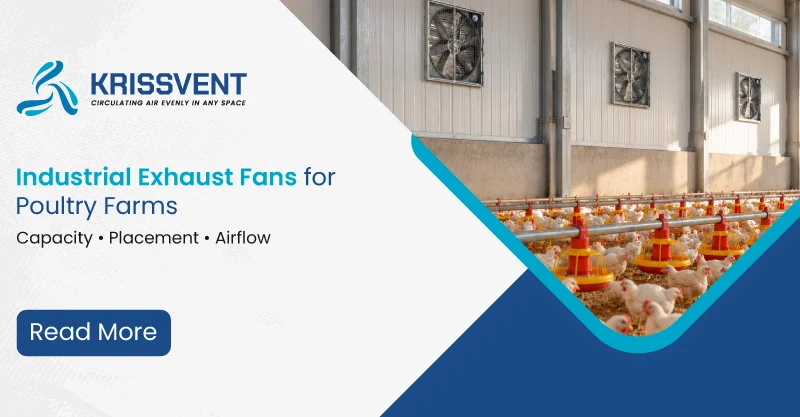
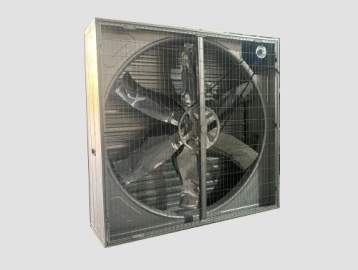
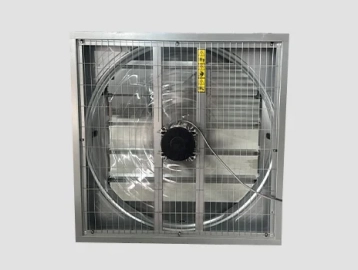
Poultry farms need controlled ventilation to remove heat, moisture, gases, dust and stale air from enclosed sheds. Industrial exhaust fans for poultry farms help maintain continuous air exchange by pulling warm, contaminated air out while allowing fresh air to enter through planned inlets.
The right setup depends on shed dimensions, bird density, climate, ventilation type and the airflow required at bird level.
Why Are Exhaust Fans Important in Poultry Farms?
A poultry shed can quickly build up heat, humidity, dust and gases when ventilation is insufficient.
Industrial exhaust fans help to:
- Remove excess heat from the shed
- Control moisture and humidity
- Reduce stale air and odours
- Support fresh-air exchange
- Improve airflow around birds
- Maintain more uniform conditions across the shed
In negative-pressure poultry houses, exhaust fans create lower pressure inside the building so replacement air enters through designated inlets.
How Much Exhaust Fan Capacity Does a Poultry Farm Need?
There is no single exhaust fan capacity suitable for every poultry shed.
The required airflow depends on:
- Shed length, width and height
- Number and type of birds
- Bird age and weight
- Local temperature and humidity
- Minimum or tunnel ventilation design
- Air inlet size
- Static pressure
- Required air velocity
For this reason, fan selection should be based on actual airflow performance, not only fan diameter or motor power.
Fan output decreases as static pressure rises, so capacity should be checked at the expected operating pressure of the poultry house.
Simple Capacity Planning Approach
A practical starting point is:
Required airflow ÷ airflow capacity of each fan = approximate number of fans
For example, if a poultry house requires 200,000 m³/h of exhaust airflow and each selected fan provides 40,000 m³/h under the required operating conditions:
200,000 ÷ 40,000 = 5 fans
This is only an initial calculation. Actual fan quantity should also consider static pressure, air inlets, cooling pads and the complete shed layout.
You can explore our accurate industrial exhaust fan calculator
Where Should Exhaust Fans Be Placed in a Poultry House?
Placement depends on the ventilation system being used.
In a tunnel-ventilated poultry house, exhaust fans are generally installed together at one end of the shed, while fresh-air inlets or cooling pads are positioned at the opposite end.
This creates a lengthwise airflow path through the poultry house. Properly designed tunnel inlets are important because poor inlet sizing or positioning can create dead zones, uneven air movement and higher energy use.
Typical Tunnel Ventilation Layout
Fresh Air / Cooling Pads → Birds → Exhaust Fans
The objective is to move air uniformly through the occupied bird zone before it leaves the building.
How Many Exhaust Fans Should Be Installed?
The number of exhaust fans should be calculated from the total required airflow, not simply from shed size.
Consider:
- Required total ventilation capacity
- Individual fan airflow at operating static pressure
- Number of birds
- Shed dimensions
- Required tunnel air velocity
- Cooling-pad and inlet resistance
- Additional capacity for hot-weather conditions
Some reserve airflow can also be useful because dirt, shutter resistance, worn belts and other operating factors can gradually reduce fan performance.
Exhaust Fan Capacity vs Shed Size
| Poultry Shed Condition | Ventilation Consideration |
|---|---|
| Small poultry shed | Lower total airflow requirement |
| Long enclosed shed | Multiple exhaust fans may be required |
| High bird density | Greater ventilation demand |
| Hot and humid climate | Higher summer airflow requirement |
| Tunnel-ventilated house | High-capacity fans placed at one end |
| Shed with cooling pads | Fan performance should account for added resistance |
Rather than selecting fans only by shed area, calculate the required airflow and operating pressure first.
Why Are Air Inlets Important?
Industrial exhaust fans can only remove air effectively when replacement air has a properly designed path into the shed.
Incorrectly sized or positioned inlets can cause:
- Dead airflow zones
- Uneven air distribution
- Excess static pressure
- Lower fan airflow
- Increased energy consumption
In tunnel ventilation, the inlet is generally located at the opposite end from the exhaust fans so fresh air travels through the poultry house before being discharged.
What Should You Check Before Installation?
Before installing industrial exhaust fans in a poultry farm, confirm:
- Poultry shed dimensions
- Bird capacity and density
- Ventilation system type
- Required airflow
- Fan performance at static pressure
- Air inlet size and location
- Cooling-pad arrangement
- Fan mounting area
- Electrical power availability
- Maintenance access
Planning the fan and inlet system together gives better results than selecting the exhaust fans separately.
KRISSVENT Industrial Exhaust Fan Installations for Poultry Farms
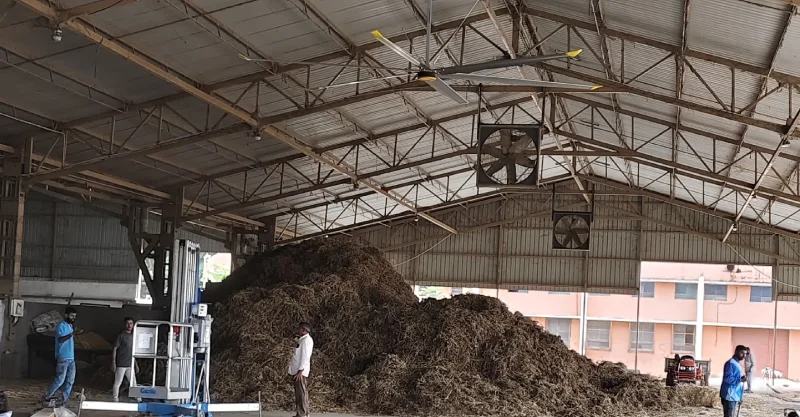
Why Choose KRISSVENT Industrial Exhaust Fans for Poultry Farms?
KRISSVENT offers industrial exhaust fans for poultry farms and other large ventilation applications.
Fan selection can be planned according to:
- Poultry shed dimensions
- Required air volume
- Ventilation layout
- Climate conditions
- Available installation space
- Number of fans required
Instead of selecting an exhaust fan only by diameter, KRISSVENT can help evaluate the airflow requirement and recommend a suitable fan configuration for the poultry shed.
Planning Ventilation for a Poultry Farm?
Share your shed length, width, height and bird capacity with KRISSVENT to identify a suitable industrial exhaust fan setup.
 +91-7624021071
FAQs
1. What size exhaust fan is best for a poultry farm?
2. How many exhaust fans are needed for a poultry shed?
3. Where should exhaust fans be installed in a poultry farm?
4. Why is static pressure important when selecting poultry exhaust fans?
5. Can exhaust fans reduce heat inside a poultry shed?
Conclusion
Industrial exhaust fans for poultry farms work best when capacity, placement and air inlets are planned as one ventilation system.
The main factors are shed dimensions, bird density, required airflow, static pressure, inlet design and local climate.
A properly planned system helps move fresh air through the poultry house while removing heat, moisture and stale air efficiently.