+91-7624021071
 Download Brochure
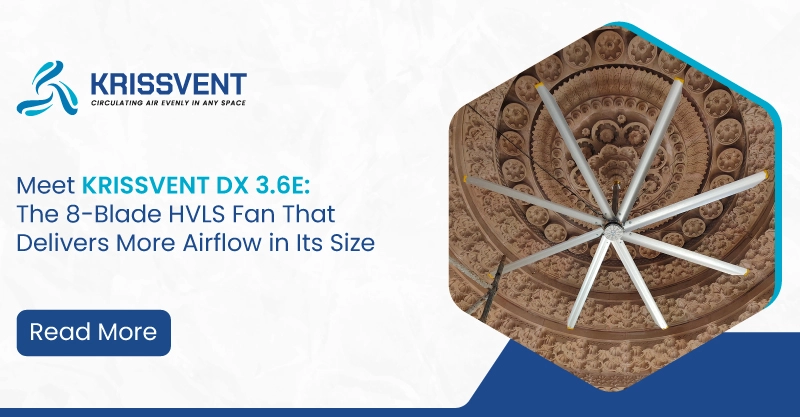
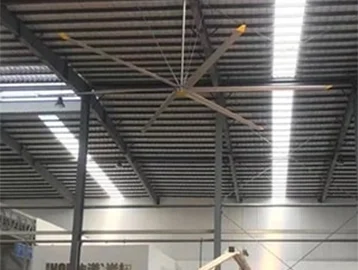
When most people think of an HVLS fan, they picture a giant 20–24-foot ceiling fan hanging in a large warehouse or aircraft hangar. And while those large models have their place, a significant number of industrial and commercial spaces in India have ceiling heights between 4 and 8 metres and those spaces have always been underserved.
Standard large HVLS fans won’t fit. Conventional ceiling fans don’t move enough air. That’s the gap KRISSVENT’s DX 3.6E was built to close.
A 12-foot fan with 8 blades, delivering 7,320 m³/min of airflow at just 0.3 KW: the DX 3.6E is the highest-performing HVLS fan in its size segment, and this blog covers everything you need to know about it.
What is the KRISSVENT DX 3.6E?
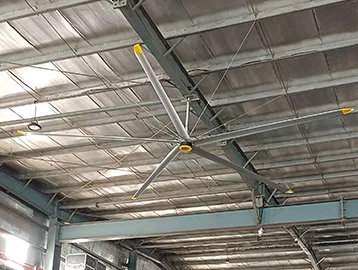
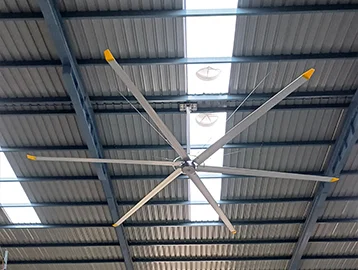
The DX 3.6E is a 12-foot HVLS (High Volume Low Speed) ceiling fan designed specifically for spaces with a ceiling height between 4 and 8 meters. It is part of KRISSVENT’s compact DX series, a range built for low-ceiling industrial, commercial, and institutional environments where larger HVLS fans cannot be installed.
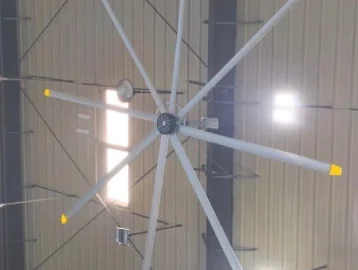
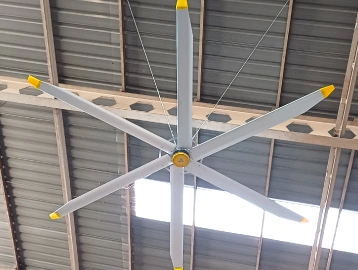
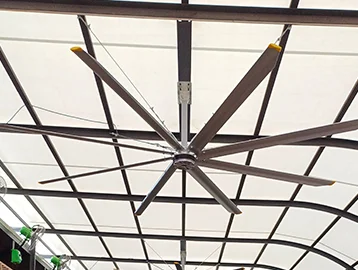
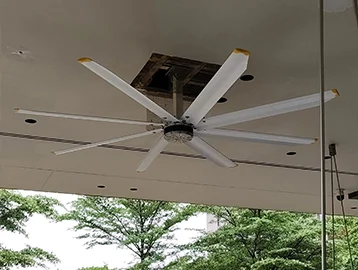
What sets it apart from other fans in its size bracket is its 8-blade configuration. Most HVLS fans at this diameter come with 5 or 6 blades. KRISSVENT’s decision to use 8 blades directly increases the blade surface area per rotation, which means more air is displaced per minute – without increasing motor size or power consumption.
DX 3.6E – Full Technical Specifications

KRISSVENT DX 3.6 E
Size: 12 ft
No of Blades: 8
Motor: 0.3 KW / 0.4HP
Max Speed: 90 RPM
Max Air Volume: 7,320 m3/min
Fit for Installation Height(M): 4 ~ 8
Net Weight: 42 kg
Noise Level (dB): <= 38
Every number here matters for a purchase decision. Let’s break down the most important ones.
Breaking Down the Key Specs – What They Mean for You
8 Blades – Why It Matters More Than Fan Size
The most common question buyers ask is: why does a 12-foot fan need 8 blades?
The answer is physics. Airflow volume is directly related to how much surface area the blades sweep per rotation. A 6-blade fan at 12 feet and an 8-blade fan at 12 feet are the same size – but the 8-blade version sweeps significantly more air per revolution.
This is why the DX 3.6E delivers airflow comparable to some 16-foot fans in the market. The blade count compensates for the smaller diameter.
7,320 m³/min – What This Number Means on the Floor
Air volume of 7,320 cubic metres per minute means the fan is displacing a large column of air and circulating it across the floor and back up to the ceiling continuously. For a worker standing in that space, this translates to a wind chill effect — the perceived temperature drops by 4 to 6 degrees Celsius even without any cooling system running.
For a plant owner or warehouse manager, it means workers stay productive longer, heat stress incidents reduce, and energy bills stay low.
0.3 KW Motor – Maximum Output, Minimum Consumption
Running a fan on 0.3 KW per hour costs approximately ₹2–3 per hour depending on your electricity tariff. For the airflow it delivers, the DX 3.6E has one of the best airflow-to-watt ratios available in a compact HVLS fan.
Compare this to running 4–6 conventional ceiling fans to cover the same area – the total wattage and noise level would far exceed what a single DX 3.6E consumes.
≤ 38 dB – Silent Enough for Any Environment
38 decibels is comparable to the ambient noise in a quiet library or a calm office. This makes the DX 3.6E suitable not just for factories and warehouses, but also for temples, canteens, schools, community halls, and retail spaces – anywhere noise is a concern.
Where Is the DX 3.6E Being Installed?
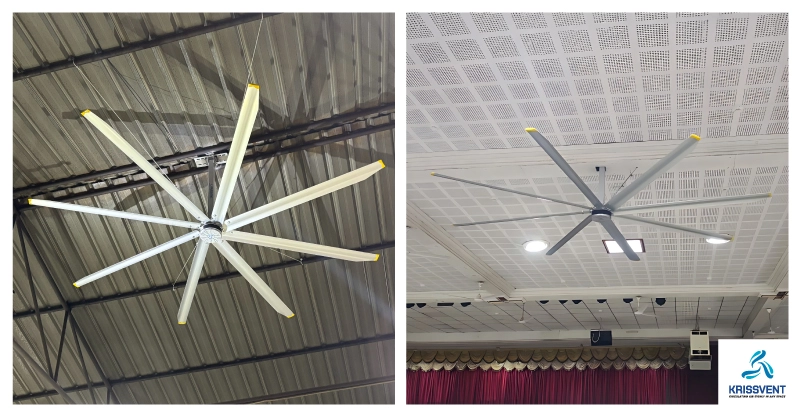
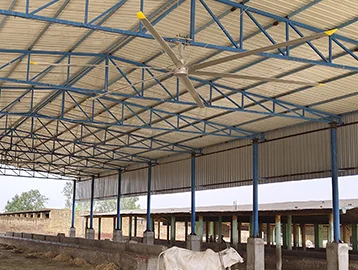
The DX 3.6E is a versatile fan. Because of its compact size, low noise, and strong airflow, it gets specified across a surprisingly wide range of applications:
- Manufacturing & Production Floors: Small to mid-size factories and assembly units where ceiling heights are typically 5–7 metres
- Warehouses & Storage Facilities: Logistics and storage spaces benefit from uniform air movement
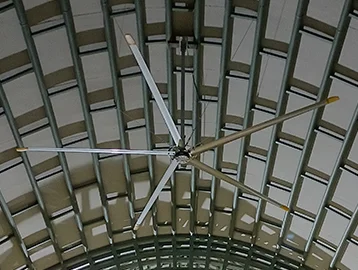
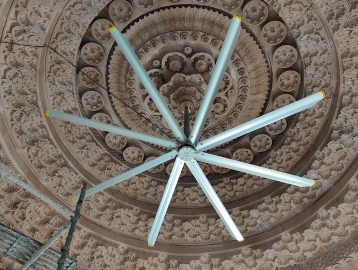
- Temples & Religious Spaces: The combination of strong airflow and near-silent operation (≤ 38 dB) made it the right choice
- Institutional Canteens & Dining Areas: University canteens, factory canteens, and hospital dining areas keep spaces fresh and comfortable
- Retail & Commercial Spaces: Showrooms, automobile service centres, and large retail stores with standard ceiling heights
How Does the DX 3.6E Compare to the Rest of the DX Series?
KRISSVENT offers two other 8-blade models alongside the DX 3.6E – for spaces where even the 12-foot diameter is too large, or where the area coverage needed per fan is smaller.
| Model | Size | Blades | Air Volume | Installation Height | Weight |
|---|---|---|---|---|---|
| DX 3.6E | 12 ft | 8 | 7,320 m³/min | 4–8 M | 42 Kg |
| DX 3.0E | 10 ft | 8 | 6,450 m³/min | 4–8 M | 38 Kg |
| DX 2.4E | 8 ft | 8 | 5,320 m³/min | 4–8 M | 34 Kg |
All three models share the same motor spec (0.3 KW / 0.4 HP) and the same noise level (≤ 38 dB). The DX 3.6E is the right choice when you want maximum airflow per fan unit. The DX 3.0E and DX 2.4E are better suited for tighter spaces or where multiple smaller fans are preferable to fewer larger ones.
Technology Behind the DX 3.6E – PMSM Direct Drive
The DX 3.6E runs on KRISSVENT’s PMSM (Permanent Magnet Synchronous Motor) technology with a direct drive system. This means:
- No gearbox, no belts, no pulleys – the motor connects directly to the fan hub. Fewer components means fewer things that can wear out or fail.
- Neodymium magnets – KRISSVENT uses rare earth Neodymium magnets in the motor. These have up to 20 times the lifespan of conventional magnets, contributing to the fan’s long operational life.
- Virtually zero maintenance – with no belts to replace, no gear oil to change, and no brushes to wear, the DX 3.6E’s maintenance requirement is limited to periodic blade cleaning and visual inspection.
- Highest efficiency per watt – PMSM motors are more efficient than conventional induction motors at partial loads, which is where most fans operate most of the time.
Is the DX 3.6E Right for Your Space?
Use this as a quick checklist before making a decision:
- Your ceiling height is between 4 and 8 metres
- You need to cool or ventilate a large open floor area
- You want lower electricity consumption than air conditioning or multiple conventional fans
- Noise level is a concern (manufacturing QC area, canteen, institutional space)
- You want a low-maintenance solution that runs reliably for years
- You’re looking for a fan that can be installed without heavy structural modifications
If most of these apply to your facility, the DX 3.6E is worth evaluating. Use KRISSVENT’s HVLS Fan Calculator to estimate how many units your space requires.
Want to know if the DX 3.6E is the right fit for your facility?
Talk to KRISSVENT’s team – share your floor dimensions and ceiling height and get a recommendation within 24 hours.
 +91-7624021071
FAQs
1. What ceiling height does the KRISSVENT DX 3.6E require?
2. Why does the DX 3.6E have 8 blades when most HVLS fans have 5 or 6?
3. How much electricity does the DX 3.6E consume?
4. Is the DX 3.6E noisy?
5. Does the DX 3.6E require regular servicing?
6. How many DX 3.6E fans do I need for my facility?
7. What is the difference between DX 3.6E, DX 3.0E, and DX 2.4E?
Conclusion
The KRISSVENT DX 3.6E solves a real and specific problem – delivering high-volume airflow in spaces that are too low for standard HVLS fans and too large for conventional ceiling fans.
With 8 blades, 7,320 m³/min of air volume, a 0.3 KW motor, and near-silent operation, it consistently outperforms other fans in the 12-foot segment. Add PMSM direct drive technology, Neodymium magnets, and zero-maintenance design – and you have a fan built for long-term, reliable performance in any industrial or commercial environment.
If your facility has a ceiling height between 4 and 8 metres and you’re still running conventional fans or paying high AC bills, the DX 3.6E is worth a serious look.