+91-7624021071
 Download Brochure
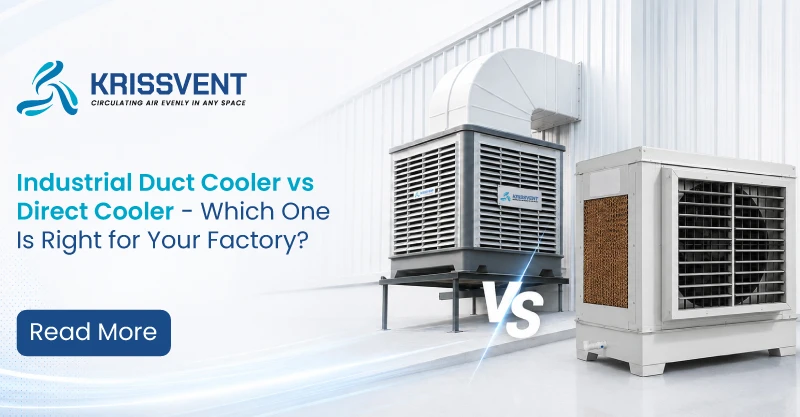
Both machines cool the same way: hot air passes through wet pads, water evaporates, and the air comes out 10 to 15°C cooler in dry summer conditions. Same technology, same low running cost.
The difference is what happens after the air is cooled. A duct cooler pushes it through ducting to outlets placed across your plant. A direct cooler blows it straight out of the unit into the space in front of it.
That one difference changes the coverage, the installation, the budget, and which factory each machine suits. Here’s how to decide.
The Difference in One Minute
A duct cooler sits outside the building or on the roof. Cool air travels through insulated ducting to outlets positioned exactly where you need them: above machine rows, over packing lines, along assembly bays. One unit serves multiple zones.
A direct cooler is self-contained. Mobile versions roll to wherever the heat is; wall-mounted versions cover a fixed zone. Air comes out of the front grille and cools whatever is within throw distance, typically a concentrated area rather than a whole hall.
Neither is “better.” They solve different problems.
Duct Cooler vs Direct Cooler: Full Comparison
| Factor | Duct Cooler | Direct Cooler |
|---|---|---|
| Air delivery | Through ducts to multiple outlets | Straight from the unit’s front |
| Coverage | 3,000 to 10,000+ sq. ft. per system | Concentrated zone per unit |
| Cooling uniformity | Even across all ducted zones | Strongest near unit, fades with distance |
| Installation | Ducting, mounting, water line; planned project | Wall unit: simple mounting; mobile: none |
| Relocation | Fixed once installed | Mobile units move in minutes |
| Upfront cost | Higher (unit + ducting + labour) | Lower (unit price, little else) |
| Cost per sq. m cooled | Lower at scale | Higher if you multiply units |
| Unit placement | Outside the building, saves floor space | Inside the space it cools |
| Best for | Whole halls, multi-zone plants | Spot cooling, small areas, shifting work |
When a Duct Cooler Is the Right Choice
Choose duct cooling if most of these describe your plant:
- The production hall is large, and workers are spread across it, not clustered in one corner
- Machine layout is fixed, so cooling needs won’t move next quarter
- You want every zone at a similar temperature, including rows far from any wall
- Floor space is tight and you can’t give any of it to cooling equipment
- You’re cooling for the long term and want the lowest cost per square metre
Typical fits: textile units, packaging plants, large fabrication halls, warehouses with fixed racking, and food processing floors.
When a Direct Cooler Is the Right Choice
Direct cooling wins when flexibility matters more than total coverage:
- Heat is concentrated in specific spots, near a furnace, a press, a loading dock
- Work locations change week to week, so fixed outlets would be wrong half the time
- You need cooling running this week, not after an installation project
- The building is rented, and you can’t modify the roof or walls
- Budget allows one or two units now, with more added later as needed
A mobile unit with a 280-litre tank runs a full shift without a water connection, moves on wheels, and needs nothing more than a plug point. Wall-mounted direct units suit fixed zones like canteens, packing corners, and supervisor cabins.
Cost: Look Past the Price Tag
Direct coolers cost less on day one, and for a small area they stay cheaper. The math flips as the area grows.
Cooling a 5,000 sq. ft. hall with direct units means buying several machines, each taking floor space, each with its own tank to fill and pads to clean. One ducted system covers the same hall from a single unit outside the building, with one maintenance point and even air everywhere.
Both types share the running-cost advantage of evaporative cooling: up to 80% less electricity than air conditioning of similar capacity. The decision is really about upfront structure, not monthly bills.
Can You Use Both? Most Factories Should
The strongest setups we install combine them: a ducted system as the base layer for the main production floor, plus one or two mobile direct coolers for the spots the ducts can’t chase, seasonal hot zones, temporary lines, maintenance bays, or outdoor loading areas in the evening.
Start with the question “where does heat hurt us most, and does that location move?” If it moves, that part of the answer is a mobile unit. If it doesn’t, duct it.
You may like to read this: Meet KRISSVENT DX 3.6E: The 8-Blade HVLS Fan That Delivers More Airflow in Its Size
Why Factories Choose KRISSVENT for Industrial Cooling
KRISSVENT manufactures both: duct-type systems designed around your machine layout, and direct coolers in mobile and wall-mounted formats with 25,000 m³/h airflow.
- ISO and CE certified equipment built for continuous industrial duty
- Site assessment first, so you get the type your building actually needs, not the one that’s easiest to sell
- Duct routing planned along machine rows for even delivery
- 9.9+ million sq. m ventilated across 200+ Indian cities
- Pan-India installation and after-sales support
Not Sure Which Cooler Fits Your Plant?
Send us your floor plan or book a free site visit. We’ll assess heat zones, layout, and budget, then recommend duct, direct, or the right mix of both.
 +91-7624021071
FAQs
1. Which is cheaper: a duct cooler or a direct cooler?
2. Which cools a large factory more evenly?
3. Can I start with direct coolers and switch to a duct system later?
4. Do duct and direct coolers use different amounts of water?
5. What should I check before choosing between the two?
Conclusion
Duct cooler or direct cooler comes down to one question: does your heat stay in one place? Fixed layout and a large floor point to a ducted system, with even air and the lowest cost at scale. Moving heat, rented sheds, or immediate needs point to direct coolers you can deploy today and reposition tomorrow.
And for most factories, the honest answer is a mix of both. KRISSVENT builds both types and will tell you which your building needs after seeing it, not before.