+91-7624021071
 Download Brochure
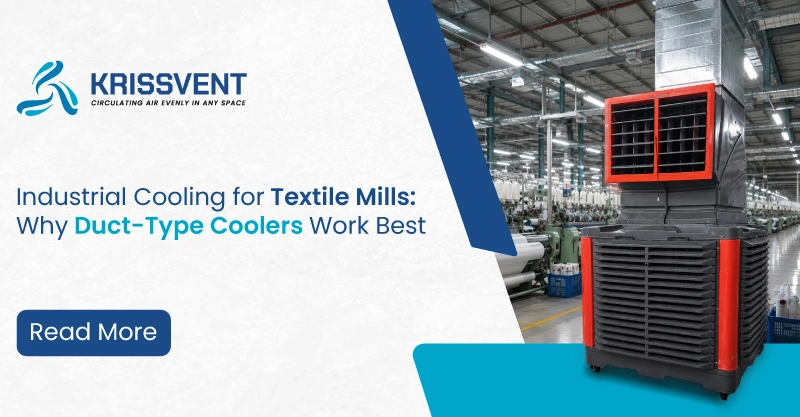
Textile mills face a cooling problem most factories don’t. Spinning frames, looms, and compressors generate heat around the clock, but the fix can’t be ordinary air conditioning, because AC dries out the air, and dry air ruins yarn.
Cotton, wool, and synthetic fibres all need specific humidity levels to run through machines without breaking. Any cooling system that strips moisture from the air trades heat problems for quality problems.
This is exactly why duct-type industrial air coolers have become the standard choice for spinning and weaving units. They lower the temperature and raise humidity at the same time, which is precisely what a textile floor needs.
Why Textile Mills Are So Hard to Keep Cool
A few things make mills tougher to cool than a typical factory:
- Machines run continuously, adding heat to the floor every hour of every shift
- Halls are long and densely packed, so air from wall units never reaches the middle rows
- Cotton fly and lint clog filters and settle on any wet surface near machines
- Workers do physical, repetitive work close to hot machinery
- Above all, the air must stay within a set humidity band, or yarn quality drops
That last point rules out most cooling options before you even compare prices.
The Humidity Factor: Why AC Works Against Textile Production
Fibre behaves differently depending on the moisture in the air around it. Dry fibre turns brittle, sheds more, builds static, and snaps under tension. Each yarn break means a machine stop, an operator intervention, and a possible defect in the finished fabric.
Recommended humidity levels by process:
| Textile Process | Ideal Relative Humidity |
|---|---|
| Cotton spinning | 50–65% RH |
| Weaving | 60–70% RH |
| Cotton & linen processing | 70–80% RH |
| Wool processing | 60–70% RH |
Air conditioning dehumidifies as it cools, pulling the floor below these ranges. Mills that install AC often end up running separate humidification plants just to undo what the AC did, paying twice for opposite jobs.
Evaporative duct cooling does the opposite. It cools the air by evaporating water into it, so humidity rises as temperature falls. One system, both jobs.
Why Duct-Type Coolers Are the Right Fit for Textile Mills
1. Cooling and Humidity in One System
As hot air passes through the wet cooling pads, its temperature drops by 10 to 15°C in dry summer conditions while its moisture content rises toward the range yarn needs. Mills using evaporative systems have reported yarn breakage reductions of around 20% in spinning sections.
2. Even Air Delivery Across Long Machine Halls
This is where the duct type earns its place over mobile or wall-mounted coolers. Ducting carries cool air from the unit to outlets positioned along machine rows, so the frame at the far end of the hall gets the same air as the one near the wall. No hot pockets, no uneven yarn behaviour between rows.
3. Fresh Air In, Lint and Fly Out
Duct coolers push 100% filtered outside air into the hall, creating positive pressure that drives hot, lint-laden air out through exhaust points. Recirculating systems, by contrast, keep moving the same fly-filled air past workers and machines.
4. No Water Near the Machines
The cooler unit sits outside or on the roof, with only dry ducting entering the production area. Cotton stock, finished fabric, and electrical panels stay well away from tanks, pads, and pumps.
5. Running Costs That Suit Mill Margins
A duct air cooler consumes up to 80% less electricity than air conditioning of comparable capacity. For a mill running two or three shifts through an eight-month hot season, that difference decides whether floor-wide cooling is affordable at all.
Duct Coolers vs Other Cooling Options for Textile Mills
| Option | Temperature | Humidity Effect | Fit for Textile Mills |
|---|---|---|---|
| Duct-type air cooler | Drops 10–15°C | Raises RH (helps yarn) | Excellent |
| Air conditioning | Drops sharply | Dries air (harms yarn) | Poor without added humidification |
| Mobile/spot coolers | Cools nearby zone only | Raises RH locally, unevenly | Limited to small areas |
| Fans alone | No drop, felt cooling only | None | Support role only |
Where Duct Cooling Delivers the Most in a Mill
- Spinning sheds, where consistent RH directly controls end breaks
- Weaving halls, where static and thread friction rise in dry air
- Winding and warping sections with dense machine layouts
- Packing and inspection areas, where worker comfort lifts accuracy
One caution: humidity should stay within the target band, not above it. A properly sized system with controlled airflow keeps RH in range; an oversized one can overshoot. This is why sizing starts with a site assessment, not a catalogue.
You May Like to Read This: 5 Things to Check Before Installing an Industrial Duct Cooler
Why Textile Mills Choose KRISSVENT
KRISSVENT designs duct cooling systems around the mill, not the other way round. Airflow of 25,000 m³/h per unit, duct layouts planned along machine rows, and pad-and-pump systems built for continuous multi-shift operation.
- ISO and CE certified equipment
- 9.9+ million sq. m ventilated across 200+ cities in India
- Duct routing designed after studying your machine layout and heat load
- Water consumption of just 25 to 30 litres per hour per unit
- Installation and after-sales support across all textile belts, from Gujarat to Tamil Nadu
Is Heat and Dry Air Hurting Your Mill’s Output?
Get a free site assessment for your spinning or weaving unit. Our team will map duct routes, heat load, and humidity targets before recommending a system.
 +91-7624021071
FAQs
1. Why is a duct air cooler better than AC for a textile mill?
2. What humidity level should a textile mill maintain?
3. Can duct coolers actually reduce yarn breakage?
4. Do duct air coolers help with cotton fly and lint?
5. How many duct coolers does a spinning mill need?
Conclusion
For most factories, cooling is about comfort. For a textile mill, it’s about comfort and yarn quality together, and that second requirement is what makes duct-type evaporative coolers the best fit. They bring temperatures down, hold humidity in the range fibre needs, spread air evenly across long machine halls, and cost a fraction of AC to run.
KRISSVENT designs, sizes, and installs duct cooling systems for spinning and weaving units across India. Start with a site assessment, and cool the mill the way the yarn wants.